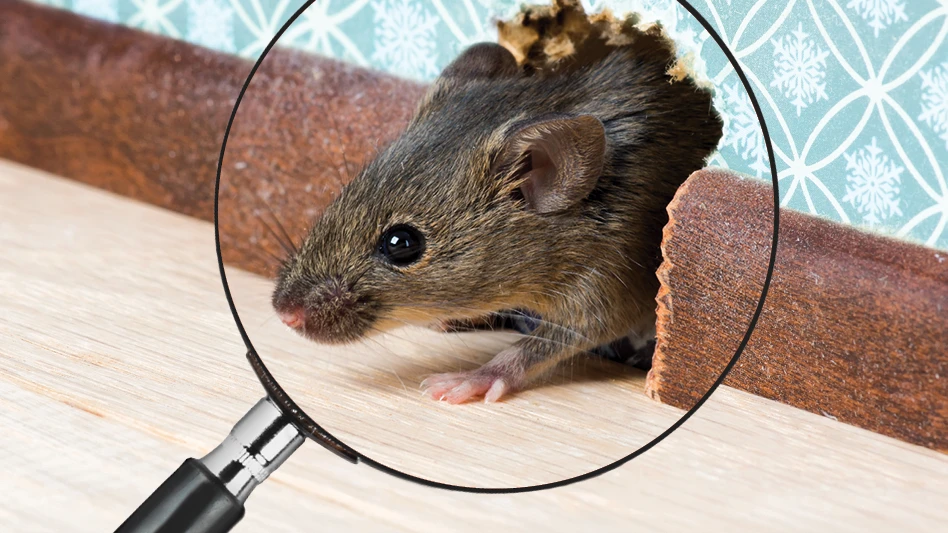
To stay ahead of potential infestations, it’s crucial to understand where rodent activity is most likely to occur — both in the usual spots and in places you might not expect. Fortunately, there are effective products and proven strategies to help professionals safeguard these pressure points and maintain a rodent-free environment.

Rollup doors, for example, protect entry points from a segregated receiving zone, and areas where products are cold packed are curtained off to prevent dust spread that could entice pests like rodents.
“We put bait stations in our freezers,” said Billie L. Johnson, Ph.D., food safety and regulatory compliance, BHJ North America. “Mice can adapt to cooler conditions quickly, especially if there is a food source available to them.”
One strategy to gain insights is staging and “putting yourself into the production process,” said Matt Shockley, QA manager of Teri Nichols Institutional Food Merchants (IFM), with facilities in Brooklyn and Hauppauge, N.Y. Shockley uses staging to gain a better understanding of rodent pressure points within facilities.
Shockley, like other professionals, understands that many culprits are obvious, but others are not. When asked where mice and rats were spotted in and around facilities, survey respondents mainly pointed to trash areas (inside and out), warehouse storage, the exterior and loading docks.
PRESSURE POINT: SUPPLIER TRAILER HITCHHIKER.
The trailer pulled into Teri Nichols IFM’s loading dock area, where the driver was greeted by staff who began a routine inspection of its contents. A culture of “see something, say something” empowers everyone on the team to own pest sightings and follow through with reporting, Shockley said.
It wasn’t a live one.
“A rodent was actually crushed under some boxes that came from another distribution center, and we had to reject the entire load,” Shockley said. “Whoever loaded the products onto the pallet smashed it, so we continued with our course of action.”
CALL TO ACTION.
Teri Nichols IFM requested a course of action from the distributor outlining its pest mitigation strategies and processes for determining the root cause of the rodent. Shockley said his company routinely reviews its Hazard Analysis Critical Control Point (HACCP) protocols involving hazard analysis, identifying critical control points, establishing limits, monitoring, correction actions and record keeping.
PRESSURE POINT: FOUNDATION ENTRY POINTS.
Teri Nichols IFM’s Brooklyn warehouse is in a former Barron’s book facility, not built to food safety and quality standards.
The good news: “It’s not on ground level and a bit raised up,” said Shockley. However, gaps and cracks offered a red-carpet entry to the inside.
“Bushes were planted right up against the building,” Shockley said of an immediate tear-out to mitigate pest pressure.

CALL TO ACTION.
Over the last four years, Shockley said the facility has been 80% renovated.
“Any level where there was potential for harborage was completely transformed,” he said of sealing the foundation, clearing landscaping 18+ inches from the building, new dock levelers and an interior gut job.
PRESSURE POINT: HERE TO CHILL.
“I have often had people question why we put rodent bait stations in our freezers,” said Johnson. But mice adapt when motivated by places to burrow with food to eat.
“I’ve seen mice and rats in freezer conditions where they find pallets and make a nice little harborage because they have plenty of nutritional opportunities,” she said. “And in the summer, they’re looking for a place to cool off.”
CALL TO ACTION.
BHJ treats freezers and coolers like any other food processing and storage area that is protected with rodent monitoring and bait stations. And records from the company’s pest control provider show success from covering all the bases — including the freezing ones.
PRESSURE POINT: FARMING OUT SERVICES.
“Rodents are a hazard at any facility,” said Patrick Davis, field training coordinator at Plunkett’s Pest Control, with locations across the Midwest.
One facility the company services is in an agricultural area next to a farm. “Every fall, they have a massive influx of rodents — an interior and exterior rodent issue,” Davis said. “It’s because when the farmers are taking down the crops in the field, they’re working toward the facility, which moves the rodent population toward the plant.”
CALL TO ACTION.
“I suggested the food plant make friends with the neighbors,” Davis said. “What we needed to do was ask if they’d be willing to work from the fence that borders the food plant and move back toward the farm so the rodents follow.”
It worked.
“This shows the importance of inspection and frequent reviews of the program, using data to tell us what’s working and what’s not,” he said.

Explore the July/August 2025 Issue
Check out more from this issue and find your next story to read.
Latest from Quality Assurance & Food Safety
- Ajinomoto Foods Recalls Products Due to Potential Glass Contamination
- Grubhub Introduces Drone-Powered Food Delivery Program
- FSIS Releases 2025 Foodborne Illness Outbreak Investigations Report
- EWG Analysis Flags 111 Ingredients Added to Foods Through GRAS
- FDA Releases Risk Assessment of Foodborne Illness from Produce with Untreated BSAAO
- Catalyst Food Leaders Announces 2026 Virtual Leadership Summit
- FDA to Hold Public Meeting on Dietary Supplements
- USDA Partners with Army Corps on New World Screwworm Sterile Fly Production Facility