istock | bymuratdeniz
WASHINGTON, D.C. — U.S. Secretary of Agriculture Brooke Rollins provided an update on the U.S. Department of Agriculture’s (USDA) five-pronged strategy announced in February to combat Highly Pathogenic Avian Influenza (HPAI) on June 26.
“When President Trump entered office, the cost of eggs was at a record high, seriously denting consumers’ wallets after years of awful inflation,” said Rollins. “On my first day as secretary, we got to work to implement a five-pronged strategy to improve biosecurity on the farm and lower egg prices on grocery store shelves. The plan has worked, and families are seeing relief with egg prices driving food deflation in the April Consumer Price Index.”
The USDA reported that wholesale egg prices have dropped 64%, with retail prices falling 27% from their peak earlier this year.
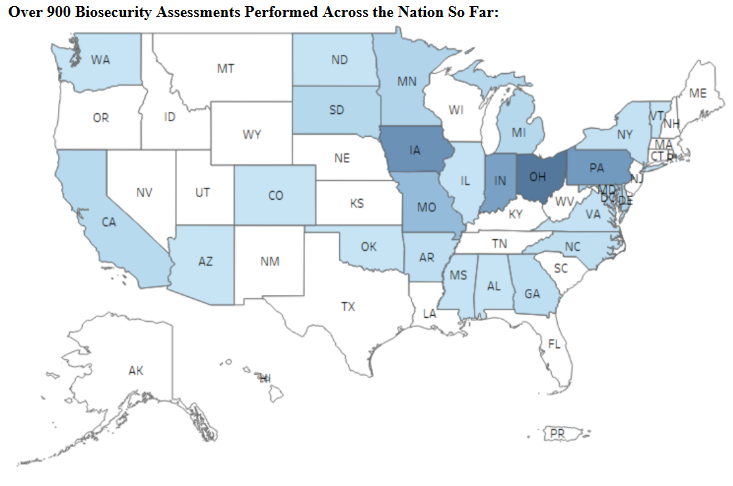
“While we are proud that over 900 biosecurity assessments have been conducted to date, resources remain available, and we are urging poultry farmers of all sizes to get your assessments done today before a potentially challenging fall,” said Rollins.
The USDA provided the below map and list of how states are stacking up on biosecurity assessments. The agency said states are strongly encouraged to take action and assist producers in scheduling their assessments.
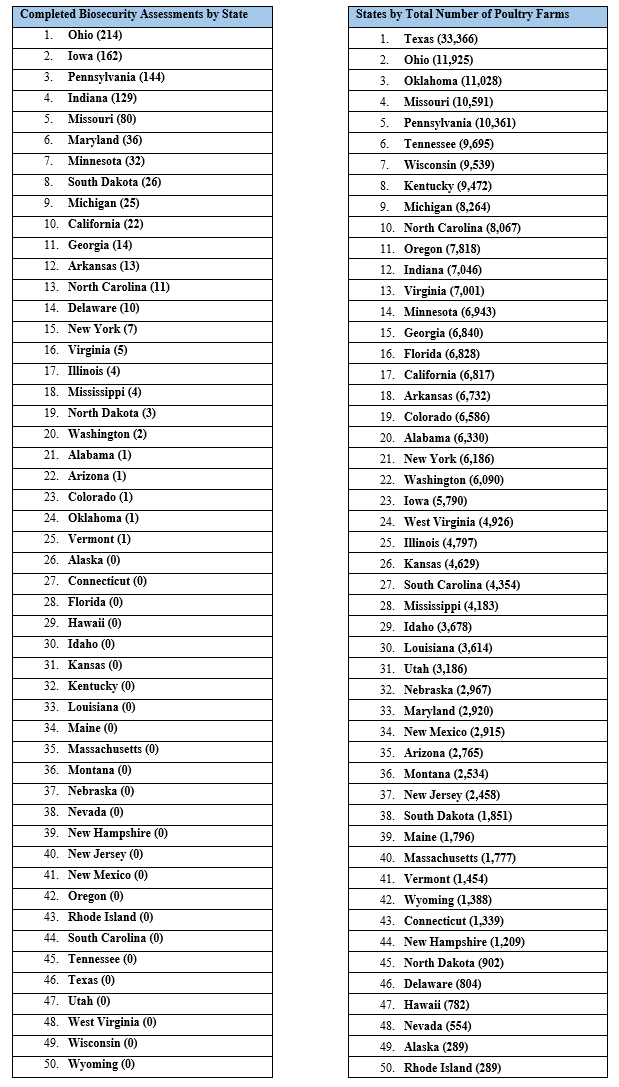
USDA said it is covering the full cost of the assessments, as well as supporting part of the costs for biosecurity improvements on farms to help strengthen the biosecurity of the nation’s poultry flock.
USDA offers two free, voluntary biosecurity assessments to help farmers get ahead of any potential HPAI threats. One focuses on wildlife risk mitigation and another on general biosecurity improvements.
Wildlife Biosecurity Assessments have been successful in safeguarding farms from the spread of HPAI from wild birds, USDA said. These additional safety measures have proven to minimize flu cases, according to the agency. Biosecurity Incentives Assessments help poultry producers identify where they can best focus their safeguards against avian flu, the agency said.
From Jan. 20 to June 26, USDA completed 948 biosecurity assessments on farms across the United States. More information about the types of assessments completed and the updated number of participating farms is available on the public dashboard.
USDA shares up to 75% of costs to fix the highest-risk biosecurity concerns identified during the assessments, said the agency. Producers can email poultry.biosecurity@usda.gov or call 844-820-2234 to request these assessments.
The USDA reported the following progress on its five-pronged strategy:
- Expedited Relief for Farmers to Accelerate Repopulation: USDA has continued providing financial relief and support for faster repopulation of poultry flocks after an HPAI detection. Since Feb. 27, when USDA increased indemnity values available to producers affected by HPAI, over $70 million has been paid out to directly support layer flocks, the agency said.
- Reduced Regulatory Burdens to Expand Supply and Lower Prices: Rollins continues to meet with producers around the country to listen to their concerns and work to find new solutions to provide relief for their regulatory and financial burdens. USDA said it has also action “to reduce red tape for the poultry industry” by eliminating what the agency described as “redundant” worker safety data submissions and extending line speed waivers and withdrawing the proposed Salmonella Framework for Raw Poultry Products.
- Harnessed American Innovation in Avian Flu Research & Vaccine Development: USDA said it received an overwhelming response to the HPAI Poultry Innovation Grand Challenge Funding Opportunity, which closed on May 19, with 417 proposals received. Applicants proposed a total of $793 million in funding. These projects focus on a range of innovations to support research into HPAI prevention, therapeutics and potential vaccines, said USDA. The agency expects awards to be finalized by this fall.
- Leveraged Safe Import-Export to Stabilize Supply: USDA’s continued efforts to supplement domestic shell and egg products have resulted in an increase in imports to help bolster the nation’s domestic supply, the agency said. Since January, more than 26 million dozen shell eggs have been imported from Brazil, Honduras, Mexico, Turkey and South Korea for breaking and pasteurization, increasing the quantity of eggs available to consumers, said USDA. An additional 14 million egg products have been imported this year, bringing total egg imports to over 40 million, according to the agency. To compare, in 2024, U.S. egg production totaled 109 billion eggs, the agency said. To better facilitate these imports, USDA has inspected and approved three new facilities — one in Arkansas and two in New York — to receive imported shell/table eggs for breaking and pasteurization, bringing the total number of approved facilities in the United States to six.
Latest from Quality Assurance & Food Safety
- FDA Withdraws COVID-Era FSMA Guidance
- FDA Investigates Raw Cheese E. Coli Outbreak as Manufacturer Declines Recall
- USDA NIFA Launches Rapid Response Grants to Combat Emerging Agricultural Threats
- WHO to Release New Foodborne Disease Estimates for World Food Safety Day
- Ajinomoto Foods Recalls Products Due to Potential Glass Contamination
- Grubhub Introduces Drone-Powered Food Delivery Program
- FSIS Releases 2025 Foodborne Illness Outbreak Investigations Report
- EWG Analysis Flags 111 Ingredients Added to Foods Through GRAS