Photo by Jerry Martin, ARS
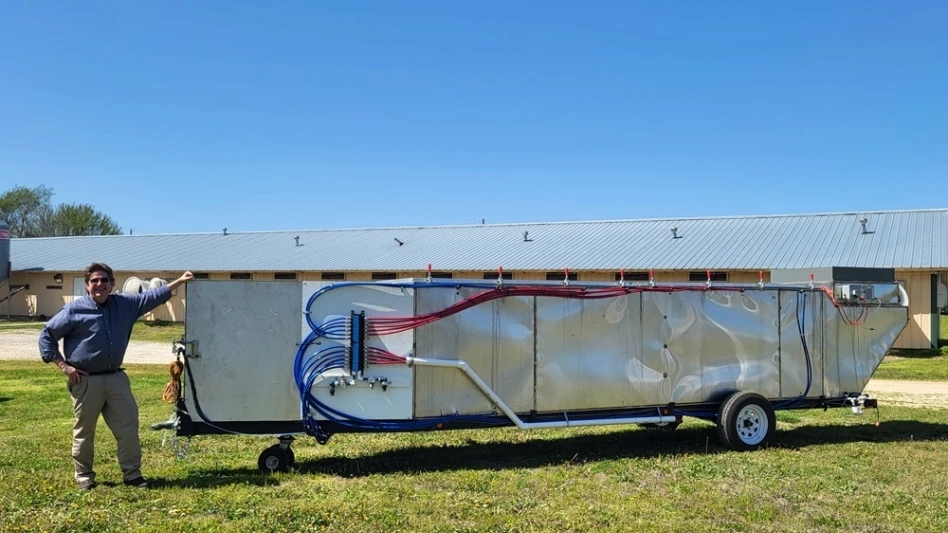
FAYETTEVILLE, Ark. — USDA's Agricultural Research Service (ARS) researchers recently developed an indoor air scrubber that purifies the air in chicken houses and reduces ammonia levels by 87% to 99%.
High levels of ammonia pose problems for poultry and agricultural workers. Ammonia, which is released from litter in poultry houses, reduces birds’ body weight gain, causes poor feed conversion and makes birds more susceptible to viral diseases, ARS said. In addition, ammonia exposure can pose health risks to agricultural workers.
Poultry manure accounts for 27% of atmospheric ammonia emissions in the United States, according to ARS, representing a significant loss of nitrogen that could otherwise be used as fertilizer for crop production.
Currently, farmers use poultry litter acidifying amendments such as adding aluminum sulfate, known as alum, to litter to reduce ammonia levels in poultry houses. However, the amendments only last up to three to four weeks, ARS said. Ammonia scrubbers offer an alternative solution; however, current systems only treat exhaust air. As a result, according to the service, they provide no direct benefits to poultry production and are not cost-effective.
To find a more economical solution for farmers, researchers from the ARS Poultry Production and Product Safety Research Unit in Fayetteville, Ark., designed and patented a full-scale prototype of an indoor air scrubber that can be easily installed in a poultry house to purify the air and save nitrogen. The scrubber has a fast sand filter that removes particulate matter from the scrubbing solution to prevent the nozzles from clogging, ARS said.
“In study trials at our testing facility, our scrubber purified the amount of air in a 40 foot by 400-foot chicken house every 30 minutes and reduced ammonia levels by 87% to 99%, depending on the ammonia concentration and the air flow rate at which it is operated,” said Philip Moore, ARS research soil scientist.
Moore and his research partners are planning to test the air scrubber in commercial poultry houses in the near future.
In addition to measuring ammonia levels, the researchers will look at how effectively the air scrubber can remove dust and pathogens from the air, such as viruses responsible for avian influenza and other pathogens that cause foodborne illnesses.
“This innovative technology could transform livestock production in poultry and potentially swine housing operations by improving animal welfare and worker safety, reducing disease transmission risks, and increasing farm profitability and environmental sustainability,” said Moore.
The study was published in the Journal of Applied Poultry Research and done in collaboration with the ARS Poultry Research Unit at Mississippi State University, MS, and the University of Delaware’s Department of Animal and Food Sciences.
Latest from Quality Assurance & Food Safety
- Food Safety Caucus Urges FDA to Force Raw Farm Recall in Response to E. Coli Outbreak
- Mettler Toledo Launches eGuide on Preventing Physical Contamination
- Aston University and Mondelēz International Partner to Reimagine Food Engineering Technologies
- Rep. DeLauro, Sen. Casey Introduce Infant Formula Made in America Act
- FDA Releases the CORE 2024 Annual Report
- FSIS Shares Lessons Learned from Listeria Outbreak Linked to Meat and Poultry
- Vitsab Showcases Freshtag Time-Temperature Monitoring Labels at Seafood Processing North America 2026
- USDA Proposes to Delay Effective Date of Poultry Grower Payment Systems Final Rule