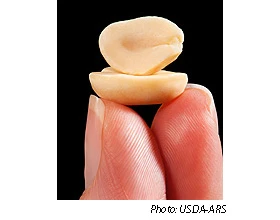
A phytochemical compound called tannic acid may be an effective scavenger of peanut allergens, according to a study by U.S. Department of Agriculture (USDA) scientists. The study was conducted by Agricultural Research Service (ARS) food technologist Si-Yin Chung and support scientist Shawndrika Reed, in the agency's Food Processing and Sensory Quality Research Unit in New Orleans, Louisiana. ARS is USDA's chief intramural scientific research agency.
The researchers wanted to see if tannic acid can react with peanut allergens in a way that would help reduce or prevent allergic responses that are induced when people accidentally ingest peanut residues contained in food products. Tannic acid, or tannin, is a phenolic antioxidant commonly found in legumes, coffee, tea, and certain tree barks. It has been shown to bind to allergenic protein fragments.
Chung and his colleagues studied whether mixing tannic acid with major peanut allergen proteins (Ara h 1 and Ara h 2) would form stable complexes (pellets) that could prevent release of the peanut allergens in the human stomach and gut. If so, the allergen complexes could be excreted and an allergic reaction could be reduced or possibly prevented. Allergic reaction occurs when an antibody called immunoglobulin E binds to the allergenic protein fragments, leading to the release of histamines.
For the study, Chung mixed four different levels of tannic acid in peanut butter extract. The pellets that were formed and collected were each tested in a solution at the acidic level of the human stomach (pH 2) and then in another solution at the alkaline level of the intestines (pH 8). The solutions were analyzed for allergens that might be released from the pellets under those pH conditions. Results showed that the pellets formed at tannic acid concentrations greater than 0.5 milligrams per milliliter of peanut butter extract did not release major peanut allergens at either pH level.
The study shows that tannic acid holds promise as a scavenger that binds to allergenic peanut proteins and keeps those proteins from being released in the stomach and gut after ingestion.
Read more about this research in the July 2014 issue of Agricultural Research magazine.