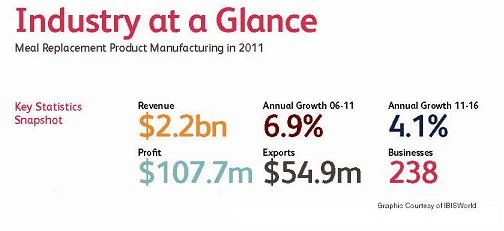
The meal replacement product manufacturing industry has experience strong revenue growth over the last five years. The expectation, according to a report by IBISWorld, is that revenue will grow 9.3% to $2.2 billion in 2011 and as the economy recovers and disposable income rises, more consumers will likely increase their spending on discretionary goods. From 2011 to 2016, the industry’s revenue is expected to grow at an average annual rate of 4.1% to $2.7 billion.
The industry manufactures meal replacement products and protein supplements, including edible bars, powdered products, and ready-to-drink shakes. Its thriving revenue has been caused, at least in part, by rising obesity rates and robust demand for convenient food products, the report said. In addition, because these products are cheaper than other forms of weight loss goods, consumers continue to buy them even during tight economic times.
IBISWorld expectations for coming years are that:
- Demand will continue as Americans continue to struggle with weight loss and others desire to improve their nutrition.
- As job opportunities increase and many Americans go back to work, their limited free time and desire for convenience will bring revenue to the industry.
- However, the industry will likely experience higher input costs and face strong competition from weight loss services. Many Americans will be able to purchase more expensive weight loss treatments as the economy rebounds and disposable income expands.
- The number of industry companies is expected to increase. In the five years to 2016, enterprises are expected to rise by an average of 2.5% per year to 269 firms. With profit margins of about 4.9% and revenue continuing to rise, this industry is quite attractive to new entrants.
- Additionally, the healthy eating index is negatively correlated with the percentage of Americans who are overweight or obese. The demand for meal replacement products provided by the industry typically rises when the healthy eating index is falling. This driver is expected to decrease slowly during 2012.
Read the full report at IBISWorld.
Latest from Quality Assurance & Food Safety
- FDA Releases Produce Regulatory Program Standards
- Invest in People or Risk the System: Darin Detwiler and Catalyst Food Leaders on Building Real Food Safety Culture
- USDA Proposes Increasing Poultry, Pork Line Speeds
- FDA Releases New Traceability Rule Guidance
- TraceGains and iFoodDS Extend Strategic Alliance
- bioMérieux Launches New Platform for Spoiler Risk Management
- SafetyChain Receives SOC 2 Type 2 Certification
- Puratos Acquires Pennsylvania-Based Vör Foods