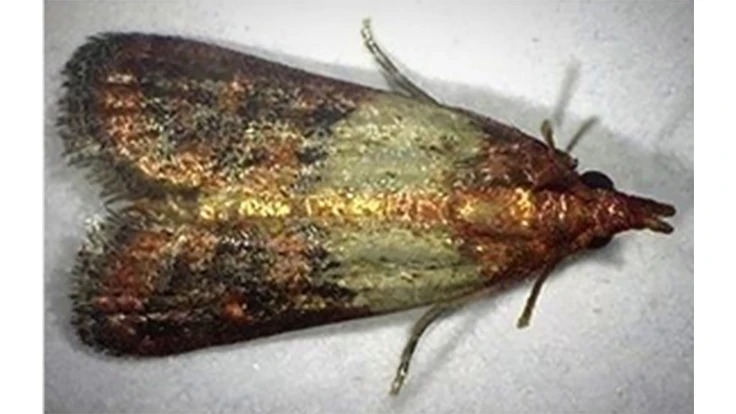
One insect is found more often than any other on stored food and grain in the United States. This is the Indian meal moth. Since they feed on any items containing grain or cereal products, the Indian meal moth (IMM) alone is responsible for many of the insect problems associated with the food industry.
As one of the easiest stored food insects to identify, the adults have a colorful appearance and the larvae (which look like greenish or yellow worms) leave a silken webbing trail wherever they crawl. Newly emerged adults have bi-colored (copper and tan) wings and measure about ½ inch from top to bottom. The IMM larvae most commonly feed on grain products including flour, cereal, nuts, bird seed, pet food, popcorn, seed and meal.
Food facilities, or their pest management providers, can monitor for and trap IMM with pheromone traps. Although there is no exact number of traps that you should place within your business, there are some general guidelines.
- In open warehouse settings, place traps on a grid of every 25 - 50 feet.
- Individual storage or production rooms should have their own set of traps.
- Place traps should at eye level for easy access.
- Lures are effective for two to three months, after this they should be replaced with new ones.
For more information on Indian meal moths and pheromone traps, visit Insects Limited.
Latest from Quality Assurance & Food Safety
- Director General of IICA and Senior USDA Officials Meet to Advance Shared Agenda
- EFSA and FAO Sign Memorandum of Understanding
- Ben Miller Breaks Down Federal Cuts, State Bans and Traceability Delays
- Michigan Officials Warn Recalled ByHeart Infant Formula Remains on Store Shelves
- Puratos USA to Launch First Professional Chocolate Product with Cultured Cocoa
- National Restaurant Association Announces Federal Policy Priorities
- USDA Offloads Washington Buildings in Reorganization Effort
- IDFA Promotes Andrew Jerome to VP of Strategic Communications and Executive Director of Foundation