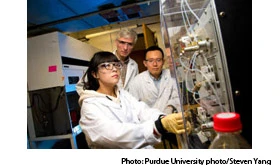
 Purdue University doctoral students, from left, Xuan Li and Seockmo Ku operate a new system that concentrates foodborne salmonella and other pathogens faster than conventional methods, representing a potential new tool for speedier detection. The research is led by Michael Ladisch, center, a distinguished professor of agricultural and biological engineering. (Credit: Photo: Purdue University photo/Steven Yang) Purdue University doctoral students, from left, Xuan Li and Seockmo Ku operate a new system that concentrates foodborne salmonella and other pathogens faster than conventional methods, representing a potential new tool for speedier detection. The research is led by Michael Ladisch, center, a distinguished professor of agricultural and biological engineering. (Credit: Photo: Purdue University photo/Steven Yang) |
Researchers have developed a system that concentrates foodborne salmonella and other pathogens faster than conventional methods by using hollow thread-like fibers that filter out the cells, representing a potential new tool for speedier detection, ScienceDaily reports.
The machine, called a continuous cell concentration device, could make it possible to routinely analyze food or water samples to screen for pathogens within a single work shift at food processing plants.
"This approach begins to address the critical need for the food industry for detecting food pathogens within six hours or less," said Michael Ladisch, a distinguished professor of agricultural and biological engineering at Purdue University. "Ideally, you want to detect foodborne pathogens in one work shift, from start to finish, which means extracting the sample, concentrating the cells and detection.
Source: Purdue University (2013, October 15). Device speeds concentration step in food-pathogen detection. ScienceDaily.
Latest from Quality Assurance & Food Safety
- Director General of IICA and Senior USDA Officials Meet to Advance Shared Agenda
- EFSA and FAO Sign Memorandum of Understanding
- Ben Miller Breaks Down Federal Cuts, State Bans and Traceability Delays
- Michigan Officials Warn Recalled ByHeart Infant Formula Remains on Store Shelves
- Puratos USA to Launch First Professional Chocolate Product with Cultured Cocoa
- National Restaurant Association Announces Federal Policy Priorities
- USDA Offloads Washington Buildings in Reorganization Effort
- IDFA Promotes Andrew Jerome to VP of Strategic Communications and Executive Director of Foundation