FDA's food labeling regulations require food producers to disclose to consumers and others specific information about themselves or their products on the label or labeling of their products. Related regulations require that food producers retain records establishing the basis for the information contained in the label or labeling of their products and provide those records to regulatory officials. Finally, certain regulations provide for the submission of food labeling petitions to us. We issued our food labeling regulations under parts 101, 102, 104, and 105 (21 CFR parts 101, 102, 104, and 105) under the authority of sections 4, 5, and 6 of the Fair Packaging and Labeling Act (FPLA) (15 U.S.C. 1453, 1454, and 1455) and sections 201, 301, 402, 403, 409, 411, 701, and 721 of the Federal Food, Drug, and Cosmetic Act (FD&C Act) (21 U.S.C. 321, 331, 342, 343, 348, 350, 371, and 379e). Most of these regulations derive from section 403 of the FD&C Act, which provides that a food product shall be deemed to be misbranded if, among other things, its label or labeling fails to bear certain required information concerning the food product, is false or misleading in any particular, or bears certain types of unauthorized claims. The disclosure requirements and other collections of information in the regulations in parts 101, 102, 104, and 105 are necessary to ensure that food products produced or sold in the United States are in compliance with the labeling provisions of the FD&C Act and FPLA.
Upon review of the information collection requests supporting these food labeling regulations, FDA found that the third-party disclosure burdens associated with the requirements found in Sec. Sec. 101.9(c)(2)(ii) and 101.36(b)(2) to declare the amount of trans fatty acids present in a food, and with the voluntary declaration of the quantitative amount and the percent of Daily Value of a dietary ingredient on a ``per day'' basis in addition to the required ``per serving'' basis are in use without current OMB approval. These collections of information were previously approved by OMB under control numbers 0910-0595 and 0910-0395 respectively; however, the approval period for these collections has expired. To remedy this oversight, to most appropriately streamline these information collections, and to eliminate redundancy in its information collection requests, we seek to revise the instant collection to include these third-party disclosure elements and have included them in the burden estimates and discussion in this document in support of our approval request for OMB control number 0910-0381.
Section 101.3 of our food labeling regulations requires that the label of a food product in packaged form bear a statement of identity (i.e., the name of the product), including, as appropriate, the form of the food or the name of the food imitated. Section 101.4 prescribes requirements for the declaration of ingredients on the label or labeling of food products in packaged form. Section 101.5 requires that the label of a food product in packaged form specify the name and place of business of the manufacturer, packer, or distributor and, if the food producer is not the manufacturer of the food product, its connection with the food product. Section 101.9 requires that nutrition information be provided for all food products intended for human consumption and offered for sale, unless an exemption in Sec. 101.9(j) applies to the product. In particular, Sec. 101.9(c)(2)(ii) requires that the amount of trans fatty acids present in a food must be declared on the nutrition label on a separate line immediately under the line for the declaration of saturated fat. Section 101.9(g)(9) provides that interested parties may submit to us requests for alternative approaches to nutrition labeling requirements. Finally, Sec. 101.9(j)(18) provides that firms claiming the small business exemption from nutrition labeling must submit notice to us supporting their claim exemption. We developed Form FDA 3570 to assist small businesses in claiming the small business exemption from nutrition labeling. The form contains all the elements required by Sec. 101.9(j)(18).
Section 101.10 requires that restaurants provide nutrition information, upon request, for any food or meal for which a nutrient content claim or health claim is made. Section 101.12(b) provides the reference amount that is used for determining the serving sizes for specific products, including baking powder, baking soda, and pectin. Section 101.12(e) provides that a manufacturer that adjusts the reference amount customarily consumed (RACC) of an aerated food for the difference in density of the aerated food relative to the density of the appropriate non-aerated reference food must be prepared to show us detailed protocols and records of all data that were used to determine the density-adjusted RACC. Section 101.12(g) requires that the label or labeling of a food product disclose the serving size that is the basis for a claim made for the product if the serving size on which the claim is based differs from the RACC. Section 101.12(h) provides for the submission of petitions requesting that we change the reference amounts defined by regulation.
Section 101.13 requires that nutrition information be provided in accordance with Sec. 101.9 for any food product for which a nutrient content claim is made. Under some circumstances, Sec. 101.13 also requires the disclosure of other types of information as a condition for the use of a nutrient content claim. For example, under Sec. 101.13(j), if the claim compares the level of a nutrient in the food with the level of the same nutrient in another ``reference'' food, the claim must also disclose the identity of the reference food, the amount of the nutrient in each food, and the percentage or fractional amount by which the amount of the nutrient in the labeled food differs from the amount of the nutrient in the reference food. It also requires that when this comparison is based on an average of food products, this information must be provided to consumers or regulatory officials upon request. Section 101.13(q)(5) requires that restaurants document and provide to appropriate regulatory officials, upon request, the basis for any nutrient content claims they have made for the foods they sell.
Section 101.14(d)(2) and (d)(3) provides for the disclosure of nutrition information in accordance with Sec. 101.9 and, under some circumstances, certain other information as a condition for making a health claim for a food product. Section 101.15 provides that, if the label of a food product contains any representation in a foreign language, all words, statements, and other information required by or under authority of the FD&C Act to appear on the label must appear in both the foreign language and in English. Section 101.22 contains labeling requirements for the disclosure of spices, flavorings, colorings, and chemical preservatives in food products. Section 101.22(i)(4) sets forth disclosure and recordkeeping requirements pertaining to certifications for flavors designated as containing no artificial flavors. Section 101.30 specifies the conditions under which a beverage that purports to contain any fruit or vegetable juice must declare the percentage of juice present in the beverage and the manner in which the declaration is to be made.
Section 101.36 requires that nutrition information be provided for dietary supplements offered for sale, unless an exemption in Sec. 101.36(h) applies. In particular, Sec. 101.36(b)(2) requires that the amount of trans fatty acids present in dietary supplements must be declared on the nutrition label on a separate line immediately under the line for the declaration of saturated fat. Section 101.36(e) permits the voluntary declaration of the quantitative amount and the percent of Daily Value of a dietary ingredient on a ``per day'' basis in addition to the required ``per serving'' basis, if a dietary supplement label recommends that the dietary supplement be consumed more than once per day. Section 101.36(f)(2) cross-references the provisions in Sec. 101.9(g)(9) for the submission to us of requests for alternative approaches to nutrition labeling requirements. Also, Sec. 101.36(h)(2) cross-references the provisions in Sec. 101.9(j)(18) for the submission of small business exemption notices. As noted previously, we developed Form FDA 3570 to assist small businesses in claiming the small business exemption from nutrition labeling. The form contains all the elements required by Sec. 101.36(h)(2).
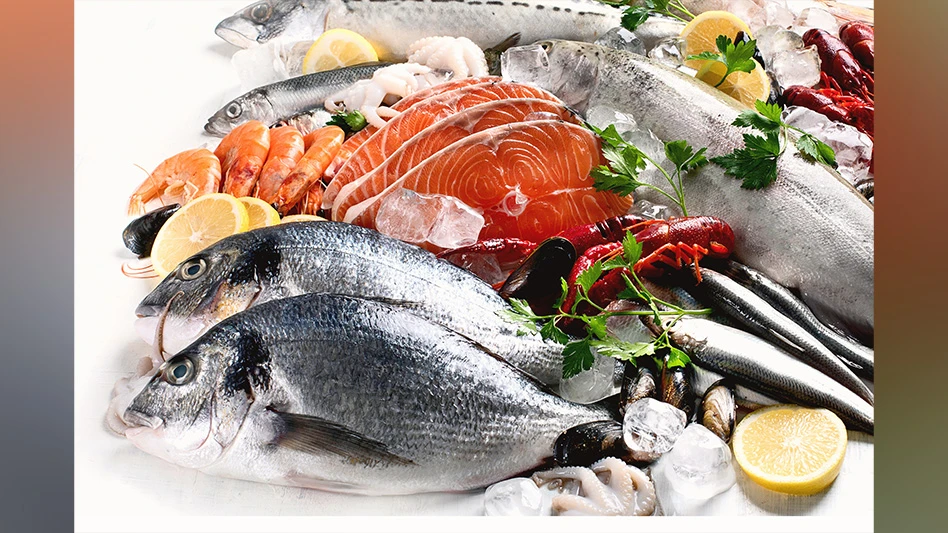
Section 101.42 requests that food retailers voluntarily provide nutrition information for raw fruit, vegetables, and fish at the point of purchase and Sec. 101.45 contains guidelines for providing such information. Also, Sec. 101.45(c) provides for the submission to us of nutrient databases and proposed nutrition labeling values for raw fruit, vegetables, and fish for review and approval.
Sections 101.54, 101.56, 101.60, 101.61, and 101.62 specify information that must be disclosed as a condition for making particular nutrient content claims. Section 101.67 provides for the use of nutrient content claims for butter, and cross-references requirements in other regulations for information declaration (Sec. 101.4) and disclosure of information concerning performance characteristics (Sec. 101.13(d)). Section 101.69 provides for the submission of a petition requesting that we authorize a particular nutrient content claim by regulation. Section 101.70 provides for the submission of a petition requesting that we authorize a particular health claim by regulation. Section 101.77(c)(2)(ii)(D) requires the disclosure of soluble fiber per serving in the nutrition labeling of a food bearing a health claim about the relationship between soluble fiber and a reduced risk of coronary heart disease. Section 101.79(c)(2)(iv) requires the disclosure of the amount of folate in the nutrition label of a food bearing a health claim about the relationship between folate and a reduced risk of neural tube defects.
Section 101.100(d) provides that any agreement that forms the basis for an exemption from the labeling requirements of section 403(c), (e), (g), (h), (i), (k), and (q) of the FD&C Act be in writing and that a copy of the agreement be made available to us upon request. Section 101.100 also contains reporting and disclosure requirements as conditions for claiming certain labeling exemptions (e.g., 101.100(h)).
Section 101.105 specifies requirements for the declaration of the net quantity of contents on the label of a food in packaged form and prescribes conditions under which a food whose label does not accurately reflect the actual quantity of contents may be sold, with appropriate disclosures, to an institution operated by a Federal, State or local government. Section 101.108 provides for the submission to us of a written proposal requesting a temporary exemption from certain requirements of Sec. Sec. 101.9 and 105.66 for the purpose of conducting food labeling experiments with our authorization.
Regulations in part 102 define the information that must be included as part of the statement of identity for particular foods and prescribe related labeling requirements for some of these foods. For example, Sec. 102.22 requires that the name of a protein hydrolysate will include the identity of the food source from which the protein was derived.
Part 104, which pertains to nutritional quality guidelines for foods, cross-references several labeling provisions in part 101 but contains no separate information collection requirements.
Part 105 contains special labeling requirements for hypoallergenic foods, infant foods, and certain foods represented as useful in reducing or maintaining body weight.
The purpose of our food labeling requirements is to allow consumers to be knowledgeable about the foods they purchase. Nutrition labeling provides information for use by consumers in selecting a nutritious diet. Other information enables a consumer to comparison shop. Ingredient information also enables consumers to avoid substances to which they may be sensitive. Petitions or other requests submitted to us provide the basis for us to permit new labeling statements or to grant exemptions from certain labeling requirements. Recordkeeping requirements enable us to monitor the basis upon which certain label statements are made for food products and whether those statements are in compliance with the requirements of the FD&C Act or FPLA.
Go to the FDA Federal Register Notice for additional information and details.
Source: December 30, 2013 and November 1, 2013 FDA Federal Register Notices
Comments Due By: January 29, 2014
Web site: The December 30, 2013 FDA Federal Register Notice is posted at:
http://www.gpo.gov/fdsys/pkg/FR-2013-12-30/html/2013-31215.htm
The November 1, 2013 FDA Federal Register Notice is posted at:
http://www.gpo.gov/fdsys/pkg/FR-2013-11-01/html/2013-25975.htm
Latest from Quality Assurance & Food Safety
- FDA Releases Produce Regulatory Program Standards
- Invest in People or Risk the System: Darin Detwiler and Catalyst Food Leaders on Building Real Food Safety Culture
- USDA Proposes Increasing Poultry, Pork Line Speeds
- FDA Releases New Traceability Rule Guidance
- TraceGains and iFoodDS Extend Strategic Alliance
- bioMérieux Launches New Platform for Spoiler Risk Management
- SafetyChain Receives SOC 2 Type 2 Certification
- Puratos Acquires Pennsylvania-Based Vör Foods