FAO
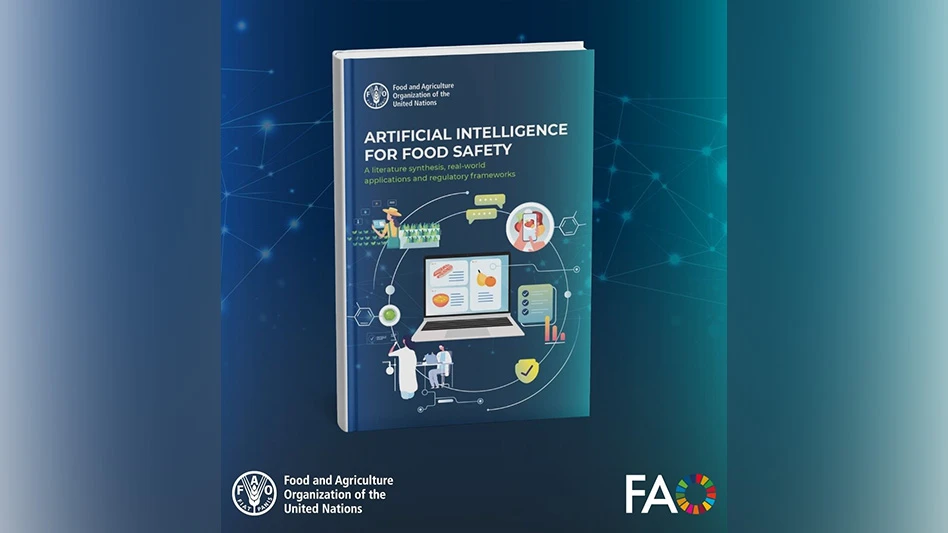
Artificial intelligence (AI) is rapidly transforming various domains, and food safety is no exception. A technical publication, “Artificial intelligence for food safety – A literature synthesis, real-world applications and regulatory frameworks,” released this month, provides a global overview of how AI is currently being deployed across laboratory testing, inspection and surveillance, border control prioritization, regulatory efficiency and risk communication.
Developed jointly by the Food and Agriculture Organization of the United Nations (FAO) and Wageningen Food Safety Research, the publication assesses 141 scientific papers from recent years and showcases practical case studies, including emerging examples from low- and middle-income countries. It also reviews global and national governance frameworks and highlights the importance of responsible and trustworthy AI adoption in the agrifood sector.
“In food safety, especially in the area of risk assessment, high-quality datasets have been extremely important for many decades,” said Masami Takeuchi, FAO food safety officer. “But unfortunately, generating and consolidating such data have been a challenge for many countries, particularly those facing priority conflicts and resource limitations. Therefore, I truly hope that the increased use of AI will prompt people to re-evaluate the need to prioritize data collection, especially considering the importance of having a high-quality dataset.”
The publication points out that while enthusiasm for AI is high, many food safety authorities face data scarcity and capacity constraints. Strengthening AI and data management literacy, particularly in the public sector, will be key to unlocking the benefits of these technologies for risk-based prevention, said FAO.
“From my academic point of view, investing in AI literacy is essential,” said Floor van Meer, one of the lead authors from Wageningen Food Safety Research. “Only when people understand what these tools can and cannot do, can they make informed choices about how to use them responsibly in food safety.”
FAO’s Senior Digital Agriculture and Innovation Specialist Erik van Ingen emphasized the opportunity to shift toward more open collaboration in this field.
“There is a wealth of knowledge around machine learning and food safety using structured data. The field of generative AI is still fairly open for food safety, and that’s something to explore more,” he said. “We could really move away from closed innovation models to an open innovation model for AI for food safety.”
The publication builds on insights gathered during a global FAO seminar held on Nov. 6, 2024, where 1,023 participants from 107 countries discussed current applications of AI in food safety and shared challenges and lessons learned. As AI continues to evolve rapidly, FAO will keep supporting members in exploring responsible solutions that help reduce foodborne risks, improve regulatory targeting and enhance global food safety, said the agency.
Latest from Quality Assurance & Food Safety
- Ajinomoto Foods Recalls Products Due to Potential Glass Contamination
- Grubhub Introduces Drone-Powered Food Delivery Program
- FSIS Releases 2025 Foodborne Illness Outbreak Investigations Report
- EWG Analysis Flags 111 Ingredients Added to Foods Through GRAS
- FDA Releases Risk Assessment of Foodborne Illness from Produce with Untreated BSAAO
- Catalyst Food Leaders Announces 2026 Virtual Leadership Summit
- FDA to Hold Public Meeting on Dietary Supplements
- USDA Partners with Army Corps on New World Screwworm Sterile Fly Production Facility