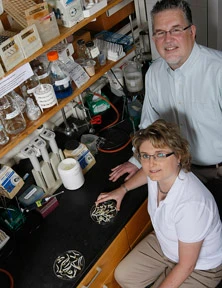
Sanitizing the outside of produce may not be enough to remove harmful food pathogens, according to a Purdue University study that demonstrated that Salmonella and E. coli can live inside plant tissues.
E. coli 0157:H7 was present in tissues of mung bean sprouts and Salmonella in peanut seedlings after the plants' seeds were contaminated with the pathogens prior to planting. Amanda Deering, a postdoctoral researcher in food science, said seeds could be contaminated in such a manner before or after planting through tainted soil or water.
"The pathogens were in every major tissue, including the tissue that transports nutrients in plants," said Deering, whose results were published in separate papers in the Journal of Food Protection and Food Research International.
Deering and Robert Pruitt, a professor of botany and plant pathology, said finding pathogens inside plants has been challenging because tests require slicing off pieces of the plants, which can move the bacteria from the outside to the inside or vice versa. It becomes difficult to know where a pathogen might have been before the plant was cut.
"The results are often imprecise because the methods allow bacteria to move," said Pruitt, a co-author of the findings.
Deering used a fixative to freeze the location of the bacteria in the plant tissues before slicing samples. Antibodies labeled with fluorescent dye were used to detect the pathogens, a process called immunocytochemistry.
"This shows us as close to what was in the plant when it was living as possible," Deering said. "The number of bacteria increased and persisted at a high level for at least 12 days, the length of the studies."
Deering said she was able to count hundreds of bacteria in almost every type of tissue.
Proper sanitization would eliminate Salmonella and E. coli from the surface of foods, but not inner tissues, Deering and Pruitt said. Cooking those foods to temperatures known to kill the pathogens would eliminate them from inner tissues.
Deering and Pruitt will continue to study the pathogens to determine how they survive inside plant tissues and possible ways to eliminate them. The U.S. Department of Agriculture's Agricultural Research Service funded their work.
Latest from Quality Assurance & Food Safety
- Director General of IICA and Senior USDA Officials Meet to Advance Shared Agenda
- EFSA and FAO Sign Memorandum of Understanding
- Ben Miller Breaks Down Federal Cuts, State Bans and Traceability Delays
- Michigan Officials Warn Recalled ByHeart Infant Formula Remains on Store Shelves
- Puratos USA to Launch First Professional Chocolate Product with Cultured Cocoa
- National Restaurant Association Announces Federal Policy Priorities
- USDA Offloads Washington Buildings in Reorganization Effort
- IDFA Promotes Andrew Jerome to VP of Strategic Communications and Executive Director of Foundation