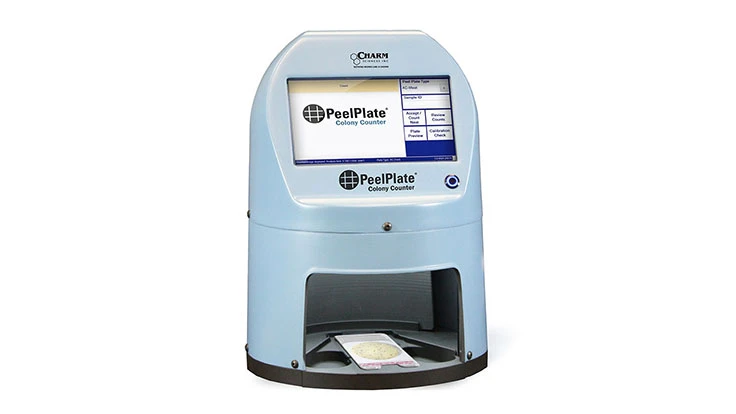
Charm Sciences has introduced the Peel Plate Colony Counter, a customizable plug & play system that counts Peel Plate microbial test colonies, stores plate images, exports and archives data from Peel Plate microbial tests.
This secure, stand-alone unit has an internal computer and is accurate within 10% of an experienced microbiologist’s visual count, the company said. For each test result the Colony Counter stores raw images, processed images, and full test result information including operator ID, sample ID, date and time of the results, count, result in CFU/mL-g etc. This information can be reviewed on the Colony Counter, copied into an excel spreadsheet, or directly transferred to an SQL database or other data management system.
“We are proud of the advancements built into our Colony Counter,” said V.P. of Engineering Rick Skiffington. “We have required calibration checks to safeguard test results, the frequency of which can be customized to each company’s requirements. Each unique Peel Plate microbial test and product type is tailored with a default dilution and can be counted using a black and white or color algorithm to categorize the type of bacterial colonies The Colony Counter is also able to detect and quantify spreader colonies. These features combined make its accuracy and ability to document Peel Plate microbial test results unequalled in the current marketplace.”
Peel Plate microbial tests are available for aerobic count (Peel Plate AC), coliform count (Peel Plate CC), E. coli and coliform count (Peel Plate EC), yeast and mold count (Peel Plate YM), enterobacteriaceae count, (Peel Plate EB), and heterotrophic count (Peel Plate HET).
Latest from Quality Assurance & Food Safety
- FDA Releases Produce Regulatory Program Standards
- Invest in People or Risk the System: Darin Detwiler and Catalyst Food Leaders on Building Real Food Safety Culture
- USDA Proposes Increasing Poultry, Pork Line Speeds
- FDA Releases New Traceability Rule Guidance
- TraceGains and iFoodDS Extend Strategic Alliance
- bioMérieux Launches New Platform for Spoiler Risk Management
- SafetyChain Receives SOC 2 Type 2 Certification
- Puratos Acquires Pennsylvania-Based Vör Foods