Cargill
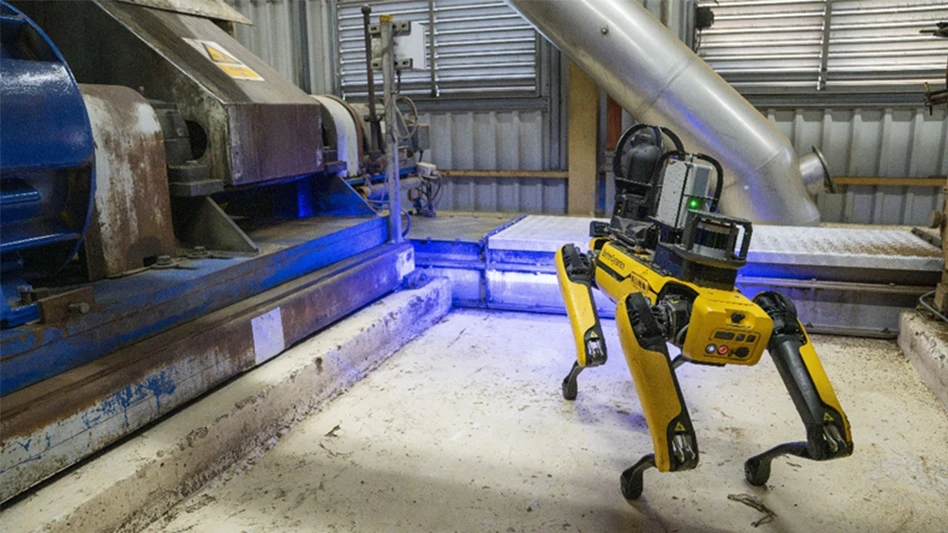
AMSTERDAM – Cargill introduced Boston Dynamics’ four-legged robot, Spot, at its Amsterdam Multiseed crush and refinery plant to support daily inspections, identify hazards in real time and enhance operational reliability. The AI-powered robot uses advanced sensors and real-time data collection to detect equipment and safety risks — helping keep operations running smoothly while protecting the people behind them, said Cargill.
Spot performs approximately 10,000 autonomous inspections per week, capturing thermal, acoustic and visual data across rapeseed and sunflower processing lines, the company said. The robot identifies maintenance issues such as equipment overheating, product leaks and ventilation faults — alerting operators before problems arise.
In one case, Cargill said Spot detected a decanter running above safe operating limits. Maintenance teams made immediate adjustments, preventing equipment failure and avoiding significant downtime. In another, Spot flagged bearings fluctuating between 40°C and 100°C, prompting lubricant replacement before damage occurred.
“Spot gives us peace of mind overnight and helps us wake up to data — not surprises,” said Martin Blommestijn, Plant Superintendent at Cargill Amsterdam. “It’s more than just a robot — it’s an early warning system that helps keep production safe and smooth.”
Spot also scans for hazards such as open doors, misplaced equipment or obstructed walkways, said Cargill.
Spot’s deployment is also changing how Cargill employees work — and how they feel about the future of food manufacturing. By automating repetitive tasks and increasing digital visibility, operators are shifting from manual oversight to data-informed decision-making, the company said.
Cargill said its team members are gaining skills in programming autonomous missions, interpreting real-time inspection data and using smart technologies to improve plant performance.
“We are building a new working environment where automation, digitalization and AI support our teams to make our manufacturing and supply chains safer and more efficient,” said Chris Kassios, smart manufacturing process lead at Cargill. “When employees see that we’re investing in their tools and training, it shows that we’re investing in their future too.”
Following successful testing and team training completed earlier this year, Cargill is evaluating how Spot could scale across other European operations, the company said.
“This pilot is just the beginning,” said Kassios. “Robotics and AI are helping us build a food system that’s not only more efficient, but more resilient, sustainable and human-centric.”
Latest from Quality Assurance & Food Safety
- FDA Releases Produce Regulatory Program Standards
- Invest in People or Risk the System: Darin Detwiler and Catalyst Food Leaders on Building Real Food Safety Culture
- USDA Proposes Increasing Poultry, Pork Line Speeds
- FDA Releases New Traceability Rule Guidance
- TraceGains and iFoodDS Extend Strategic Alliance
- bioMérieux Launches New Platform for Spoiler Risk Management
- SafetyChain Receives SOC 2 Type 2 Certification
- Puratos Acquires Pennsylvania-Based Vör Foods