Hillbrush
Editor's Note: The following was written by Mariane Hodgkinson, hygiene specialist at Hillbrush, looking at the issue of brush filament loss and how choosing and maintaining the right cleaning tools can help minimize the risk.
Cleaning plays a critical role in the management of food safety. Choosing, using and maintaining cleaning equipment and systems on site are essential to minimize the risk of microbial, allergen and foreign body cross-contamination. In turn, it's also vital for compliance to a range of regulatory requirements, food safety hazard management systems such as HACCP, external accreditations such as BRC and individual customer audits. Many of the issues relating to brush filament loss can result in contaminated finished product, prompting a recall. Unfortunately, these are often down to human error, simply choosing inferior quality cleaning brushes, the wrong brush design for the job, ineffective monitoring or not maintaining brushes correctly.
As part of a company’s food safety procedures, it is important to identify any hazards when it comes to cleaning. When related to the control of specific hazards, steps should be validated to confirm that actions are correctly set, the correct cleaning tool has been selected, the action can be repeated consistently and that the cleaning tools are delivering the right result. It should not be a question of picking any brush, but careful consideration of the selection of tools suitable for the task. Stiffness and length of filaments, brush materials and the type of soils to be removed should be considered. Investing in a cleaning audit from a brush supplier can help with planning. For example, brushes and brooms with flagged fibers, usually used for sweeping smooth floors, should not be used in dry food production areas such as bakeries since loose fibers can pose a risk of foreign body contamination (as dictated by FEIBP charter section No. 2.1). Food processors should choose brushes with extra soft or crimped plastic filaments to ensure filament retention.
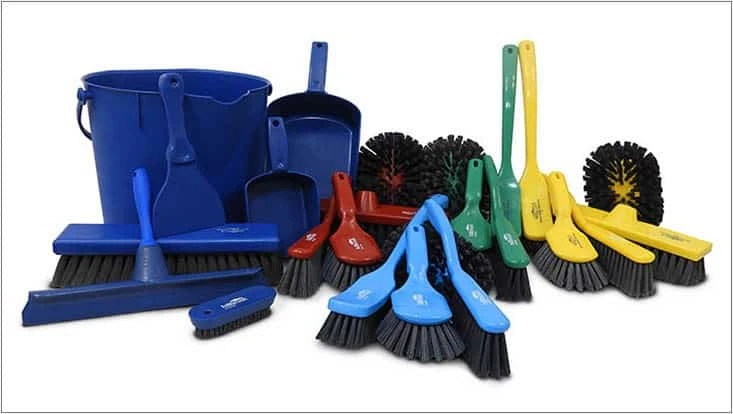
Opting for hygienically designed brushes can help to minimize the risk of filament loss. Cleaning brushes and tools made with a metal detective additive add another level of security since any contamination can be picked up via metal detection and X-ray equipment. FDA and EU food contact-approved, Hillbrush’s Total MDX brushes are specifically designed to minimize the risk of foreign object contamination in food processing. The block, filaments and resin are all metal and X-ray-detectable, and the detectable properties of the plastic used are not affected by time, moisture, cleaning or abrasion.
Reviewing the equipment or area to be cleaned needs to work hand-in-hand with tool selection. Hygienic equipment design is, of course, desirable but not always achievable when older equipment is being used. Some processing equipment may also have areas where entrapment of foreign bodies such as filaments is likely, so regular inspection should take place.
While choosing tools that are less likely to shed filaments plays a large part in minimizing risk, regular inspection procedures will verify the integrity of the tools. Failure to replace old or faulty cleaning tools and incorrect design of cleaning equipment are all key factors contributing to potential microbiological and contamination hazards.
The visual appearance of a food manufacturing facility can be the first assessment by an auditor or customer to a site and an indication of the standards and culture of the business. It can have a big impact on the outcome of an inspection.
Latest from Quality Assurance & Food Safety
- FDA Releases Produce Regulatory Program Standards
- Invest in People or Risk the System: Darin Detwiler and Catalyst Food Leaders on Building Real Food Safety Culture
- USDA Proposes Increasing Poultry, Pork Line Speeds
- FDA Releases New Traceability Rule Guidance
- TraceGains and iFoodDS Extend Strategic Alliance
- bioMérieux Launches New Platform for Spoiler Risk Management
- SafetyChain Receives SOC 2 Type 2 Certification
- Puratos Acquires Pennsylvania-Based Vör Foods