Frost & Sullivan
SAN ANTONIO — According to a Frost & Sullivanwhite paper, a range of trends, including rapid population and economic growth, globalization and urbanization, is driving the demand for food and other goods and services. This demand, in turn, is placing unprecedented pressure on producers to increase production and reduce cycle times. In an environment of enhanced safety consciousness, supply chain stakeholders must adhere closely to all regulations and obtain the required certifications. A sustainable way for stakeholders to resolve these challenges is to adopt next-gen product and sample testing solutions that employ emerging technologies such as automation, Internet of Things (IoT), and data analysis.
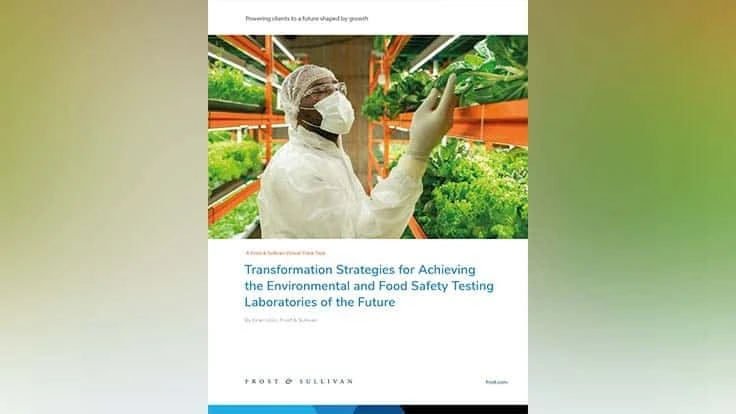
Frost & Sullivan's latest paper, Transformation Strategies for Achieving the Environmental and Food Safety Testing Lab of the Future, analyzes the value that automated testing technologies can bring to brands in an era of remote working. It gives labs a deep understanding of the current market environment and where they need to start on the automation lifecycle.
"Industry 4.0 technologies seemed like a pipe dream in laboratory testing services, even until 18 months ago. Although forward-looking analytical instrumentation vendors started infusing advanced automation technologies into their instrumentation, testing labs were yet to be convinced of their business case," observed Kiran Unni, industrial technologies vice president at Frost & Sullivan. "However, with COVID-19 accelerating the digital transformation of businesses, stakeholders all along the supply chain have begun to adopt robotics and sensors to remotely monitor the testing processes and results."
"As we design our next generation of instruments, we are looking to incorporate more sensing technologies to give users a truly digital experience," noted August Specht, vice president of R&D for chromatography and mass spectrometry at Thermo Fisher Scientific. "Our solutions will address the customer demand for increased workflow automation through robotics and automated algorithms that can connect the user to the instruments remotely. The testing systems will also meet the need for superior diagnostics, better data access for users all over the world, and remote training for employees and customers."
Overall, testing technologies that simplify remote operations will be pivotal to labs' digital transformation for several reasons, Frost & Sullivan said:
- As food supply chains become global, food testing labs must adhere to local and international governing rules.
- Laboratories need to ensure quicker turnaround times to keep pace with demand.
- Modern data analysis and software that can generate rapid and accurate reports will expedite flag reviews and enhance the capabilities of the testing laboratory.
- A shortage of personnel with the right background and training has intensified the need for more advanced automation technologies.
Latest from Quality Assurance & Food Safety
- FDA Releases Produce Regulatory Program Standards
- Invest in People or Risk the System: Darin Detwiler and Catalyst Food Leaders on Building Real Food Safety Culture
- USDA Proposes Increasing Poultry, Pork Line Speeds
- FDA Releases New Traceability Rule Guidance
- TraceGains and iFoodDS Extend Strategic Alliance
- bioMérieux Launches New Platform for Spoiler Risk Management
- SafetyChain Receives SOC 2 Type 2 Certification
- Puratos Acquires Pennsylvania-Based Vör Foods