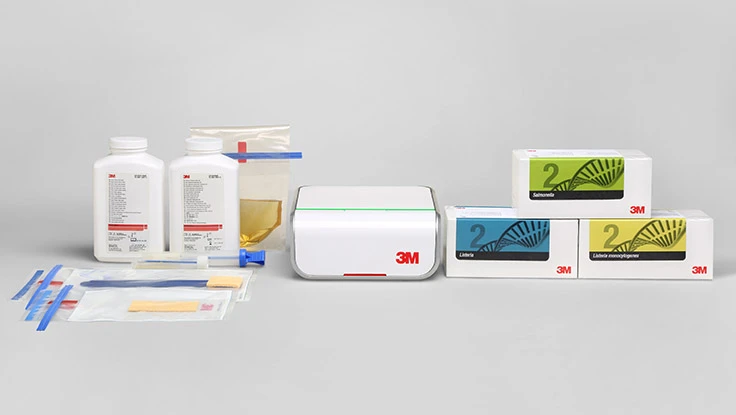
3M Food Safety has launched an addition to its next generation 3M Molecular Detection Assays: the 3M Molecular Detection Assay 2 – Salmonella. This new test, enhanced with a proprietary 3M nanotechnology, provides a streamlined workflow and simplifies pathogen testing, the company said. Additionally, all 3M Molecular Detection Assay 2 tests – Salmonella, Listeria, and Listeria monocytogenes – use a single assay protocol, enabling batch processing of samples and improving efficiency in the laboratory. Incorporation of a unique color-change indicator provides increased confidence during the process. Compared to first generation tests, assay processing time is 30% faster and instrument run time is only one hour.
Combined with short enrichment times, as low as 10 hours for 25g or composited 325g raw meat samples, these features provide flexibility in testing and allow faster critical decision making.
The new test is a part of the award-winning 3M Molecular Detection System platform, used by food processors, universities, governments and contract testing laboratories in more than 40 countries, the company said, adding, the 3M Molecular Detection System is powered by a combination of advanced technologies — isothermal DNA amplification and bioluminescence detection — to provide a pathogen testing solution that is fast, accurate, easy-to-use and affordable. All first and second-generation assays can be run simultaneously on the 3M Molecular Detection Instrument.
The 3M Molecular Detection Assay 2 – Salmonella was recently recognized by the AOAC Performance Tested Methods program (Certification #091501). The validation certifies that the next generation test kit is now equivalent or better than standard reference methods for the detection of Salmonella within a broad range of foods and environmental surfaces including: raw ground beef, raw ground chicken, cooked breaded chicken, dry dog food, black pepper, raw whole shrimp, raw bagged spinach, pasteurized processed American cheese, chicken carcass rinse, chicken carcass sponge, instant non-fat dry milk, cocoa powder, pasteurized liquid whole egg, spent sprout irrigation water, creamy peanut butter, and sealed concrete, stainless steel and sealed ceramic tile environment surfaces. For more informatio, visit www.3M.com/3MMolecularDetectionSystem/SALAOACPTM
Latest from Quality Assurance & Food Safety
- FDA Releases Produce Regulatory Program Standards
- Invest in People or Risk the System: Darin Detwiler and Catalyst Food Leaders on Building Real Food Safety Culture
- USDA Proposes Increasing Poultry, Pork Line Speeds
- FDA Releases New Traceability Rule Guidance
- TraceGains and iFoodDS Extend Strategic Alliance
- bioMérieux Launches New Platform for Spoiler Risk Management
- SafetyChain Receives SOC 2 Type 2 Certification
- Puratos Acquires Pennsylvania-Based Vör Foods