Angelo Merendino
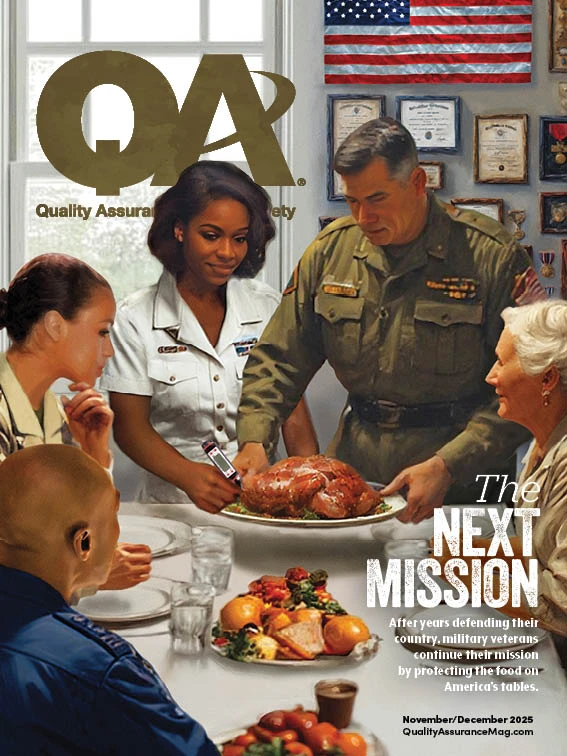
Editor's Note: This article originally appeared in the November/December 2025 print edition of QA magazine under the headline “One Mission, Many Paths.”
Every so often, a story doesn’t just land on your desk — it follows you around. It taps your shoulder at conferences, shows up in conversations and lingers when you’re writing something else entirely. This issue’s cover story (page 6) was one of those.
Over a year ago, Darin Detwiler — U.S. Navy veteran, QA contributing editor and longtime food safety advocate — approached me with a simple question: “Have you ever noticed how many veterans now work in food safety?” I hadn’t really thought of it before, but after that conversation, I couldn’t stop noticing it.
We talked about it at industry events. We traded names. We made an informal list. And that list kept growing.
What began as an interesting observation quickly revealed something bigger: across the food industry, veterans are serving again — this time in labs, processing plants, testing facilities, regulatory offices and training programs. Their uniforms may have changed, but their mission hasn’t.
Once you start looking, you realize just how many veterans work in food safety today. A recent National Restaurant Association Educational Foundation report estimated that more than 250,000 veterans now work in the U.S. food industry — many in leadership roles. Their resumes may not always spotlight military service, but the connection is clear: both share a mission of protecting the public.
The more I heard from veterans — both through Darin’s reporting and in my own conversations at industry events — the stronger that connection became. The military trains people to make decisions under pressure — not after a meeting, but in the moment. It teaches muscle memory, crisis response and the importance of training that prepares you for disruption, not convenience. It builds teams around accountability, chain of command and clarity of role. And, of course, the military emphasizes protection — of people, of systems and of public trust.
Sound familiar?
Kris Newton, U.S. Air Force veteran and business development manager at Mérieux NutriSciences, put it plain and simple: “Food safety may not involve weapons or war zones, but it demands vigilance.”
After serving as a military police officer in the U.S. Air Force, Newton transitioned into food safety and now guides companies through recalls and crisis response. When asked about pressure, she didn’t flinch: “I don’t enjoy the stress,” she said. “I’ve just prepared for it. That’s what training is for.”
Some serve with rank and ribbon. Others serve with HACCP plans and hazard analyses. But in every case, vigilance matters. Whether in a field kitchen or a processing plant, one moment of inattention can change everything.
To every veteran working in food safety — and to every team member who leads with discipline, purpose and protection of the public — thank you for your service.
It didn’t end. It just changed uniforms.
Explore the November/December 2025 Issue
Check out more from this issue and find your next story to read.
Latest from Quality Assurance & Food Safety
- USDA Terminates Paper and Packaging Research and Promotion Program
- ASI Unveils New Global Identity as Kiwa ASI
- FDA and Partners Release Findings from California Longitudinal Study
- Director General of IICA and Senior USDA Officials Meet to Advance Shared Agenda
- EFSA and FAO Sign Memorandum of Understanding
- Ben Miller Breaks Down Federal Cuts, State Bans and Traceability Delays
- Michigan Officials Warn Recalled ByHeart Infant Formula Remains on Store Shelves
- Puratos USA to Launch First Professional Chocolate Product with Cultured Cocoa