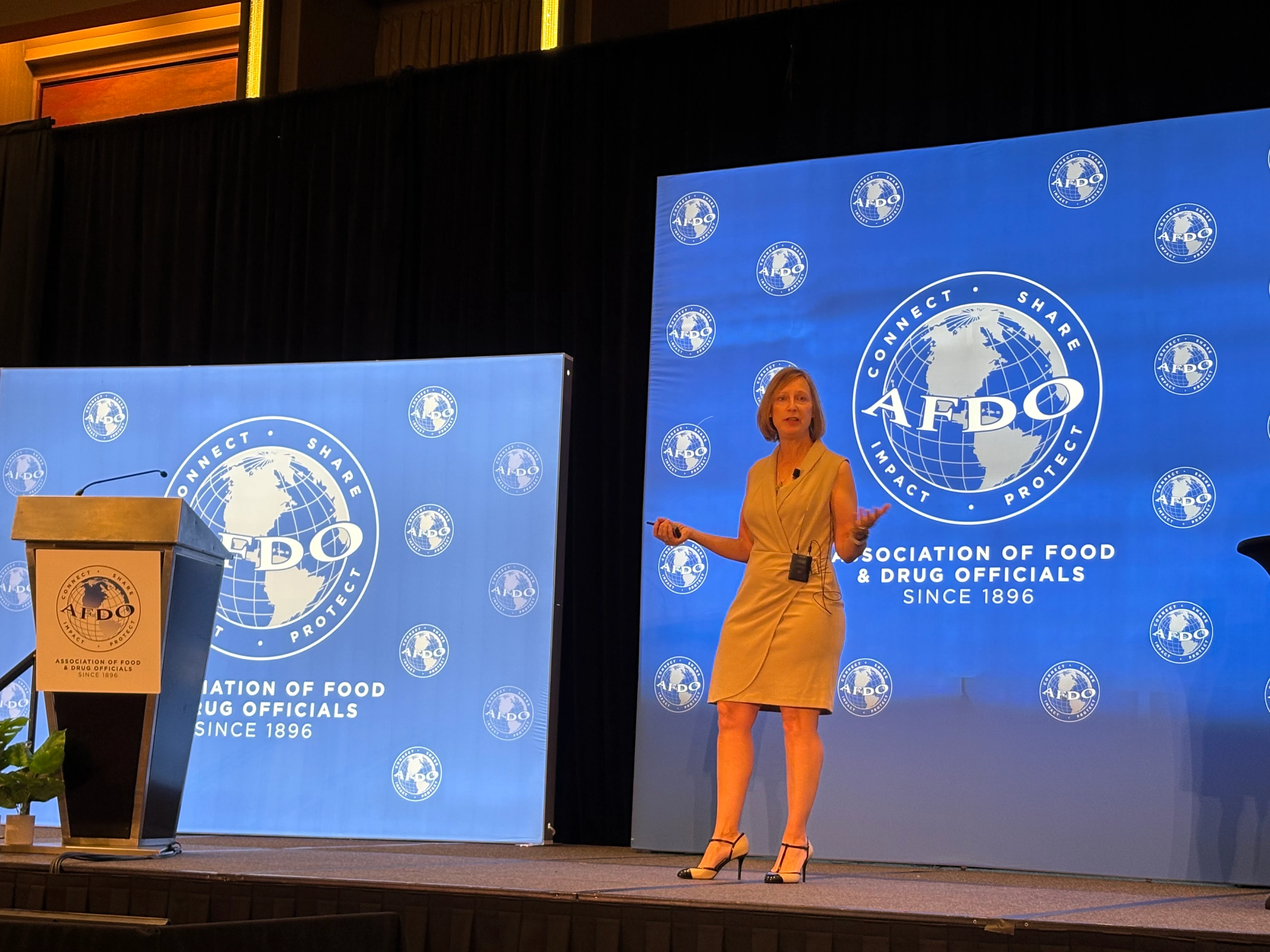
Mollie Marti’s story of resilience is born out of life and death scenarios.
In response to a series of young suicides plaguing her small hometown in Iowa, the former psychology professor created a community resiliency project in 2011 to help those in need of hope and positivity. Her effort has since grown into a full nonprofit known as the Worldmaker Resilience Institute, where she’s developed the framework for the THRIVE Resilience Model.
THRIVE stands for trust, hope, routines, involvement, vision and enrichment — essential factors, Marti said, in building resilience. These work together to improve coping, learning and growth.
“When you look at the research about what grows a sense of wellness and what helps people build the capacity to withstand adversity, the first, most impactful factor is trusted relationships,” she said.
In the food industry, trusted relationships are in short supply. Since the beginning of the year, the industry has seen mass layoffs and major resignations. These moments of unplanned change have left leaders questioning how to move forward. And all of these developments have left businesses with a sense of turmoil and strife.
Even now, Marti, who hosts the Resiliency Matters TV show, said one of the defining factors in surviving change is making sure leaders and employees alike communicate and work together.
“Even in uncertainty, you can co-create solutions, protect everyone’s psychological safety and create conditions where people are empowered to say they’re struggling,” said Marti. “To the best you can, paint a picture that there is light ahead, that there is hope. Although these are tough times, we can do hard things and honor the hard while still looking toward the future.”
Marti provided insights into building resilience and finding strength in yourself and your community at work, even while the changes keep coming.
MAINTAIN YOUR CORE HUMAN NEEDS.
When all else continues to change around you, remember the things you can control, like the ability to socialize with your support system and your essential needs for sleep, nutrition and exercise. Focus on tasks that give you a sense of purpose, and find ways to enhance your sense of belonging with coworkers that share your values, along with people outside of work. By creating a solid foundation, you can better prepare yourself for future changes that arise.
“When our needs aren’t met at a deep level and we’re left feeling threatened or isolated or powerless, it erodes our mental health and our well-being,” said Marti. “Keeping your routines is important, because they offer structure and stability within unpredictable environments.”
OFFER HOLISTIC CHECK-INS.
A lot of pressure falls on leadership to implement planned and unplanned changes — especially if these changes involve shifting responsibilities within the food industry.
“Wellness check-ins can support change management by increasing self-awareness, psychological safety and trust,” said Marti. “They give team members permission to feel seen and supported but also provide crucial insight to leaders, allowing them to catch any confusion or concern along the way.”
Marti suggests regularly asking people how they’re doing physically, intellectually, emotionally and spiritually (PIES). Once you and your colleagues are familiar with the framework, you can simply ask each other, “How are your PIES today?”
“This is a simple check-in that can be done in a nonintrusive way where people share what they’re comfortable with and it’s paired with empathetic listening and supportive responses,” said Marti. “This isn’t a time for ‘fixing’ issues. The value lies in practicing self-awareness, feeling safe to share in authentic ways and feeling seen and heard.”
MODEL YOUR LEADERSHIP.
When change comes down the pipeline, be transparent about what you know, and model a sense of calm — even when you don’t have all the answers.
“Ambiguity fuels fear,” said Marti. “Panic is contagious, but so is calm. You don’t have to pretend to have all the answers. The better answer is to show up with a steadiness, a willingness to learn, a willingness to adapt and have openness to feedback. Your team is watching you. At home, your kids are watching you. And their brains are coregulating with you. So modeling calm is key.”
If certain responsibilities, policies or priorities are taken away, make sure you replace them with new ones, too.
“It’s like a child running with scissors — if you just grab the scissors out of their hand, they’re going to have a big tantrum,” said Marti. “If you take something away, give them something else. Shift your team’s priorities and reorient them quickly. These might not be long-term priorities, but knowing what you know in this moment, ask yourself how you can come together and figure out what you can focus on.”
REDISCOVER YOUR WHY.
Budget cuts, layoffs, restrictions on policy and procedure — these moments of unplanned change have a way of throwing you and your team entirely off balance. As an individual, it’s important to revisit your values and remind yourself what’s nonnegotiable.
“Your ‘why’ serves as a personal anchor that helps you stay grounded in what truly matters, even when the circumstances around you are shifting,” said Marti. “Redefining your purpose acts like a light that shines through the confusion, disorientation or indecision, and it gives you hope for the future. It guides you to clarify the next best step forward.”
Even middle managers are asked to make tough decisions. The key isn’t to use a standard of whether you would make the same decisions you are passing down to others you care for and about — it’s to find meaning in everything you do and how you do it. At the end of the day, you have to accept whether or not you can deal with those changes without compromising what you believe in.
“You have to know who you are, what you stand for and what’s most important to you,” stressed Marti. “If you’re being put into a position where you’re violating your own values, it’s a recipe for eroding mental health and resilience. While you’re in an environment where it feels like you have to enact policies or do things that don’t feel congruent to your values, you always have the control over how you do it.”
FIND A WAY TO RISE UP.
Those who aren’t leaders have a responsibility to themselves, too. Although you may not be in a position to make decisions that affect your entire company, you are in a position to hold your leaders and coworkers accountable. You can either work on making changes from the inside by progressing toward a leadership role, or you can simply show up and express your concerns alongside potential solutions. Both approaches to change management are effective if you’re willing to see them through, said Marti.
“Growing resilience is a shared responsibility,” she said. “We always have options where we can choose our thoughts, our intentions, our attitude and how we’re going to respond to a situation. We can choose to be grateful or choose to complain. If the broader levels of agency aren’t available to us, the key is to not spend unnecessary energy trying to make it different or to rail against it. It’s about really getting back into the driver’s seat of your life.”
BE PROACTIVE WITH GRATITUDE AND GROUNDING.
Stress is cumulative. That means the more change you’re faced with, the more it can pile up. And if it doesn’t affect you in the here and now, it will affect you eventually whenever the next unplanned crisis occurs, said Marti.
“We know from research that the best predictor of how someone will do the day after unplanned change is how they’re doing the day before,” she said. “What was the health of their relationships? What were their wellness routines? How deeply were their core values met? How involved were they in their community? How strong was their sense of hope or their vision for the future?”
Being proactive in the most important areas of your life is essential to building resilience. If you’re not sure where to start, Marti suggested beginning with grounding techniques like deep breathing or meditation. Embrace gratitude for the people and things you care most about to strengthen your mind to be better equipped for any changes to those relationships in the future.
“These practices can pull you from ruminating about the past or worrying about the future back into the present moment,” she said. “From here, you can move forward, one choice at a time.”

Explore the July/August 2025 Issue
Check out more from this issue and find your next story to read.
Latest from Quality Assurance & Food Safety
- Ajinomoto Foods Recalls Products Due to Potential Glass Contamination
- Grubhub Introduces Drone-Powered Food Delivery Program
- FSIS Releases 2025 Foodborne Illness Outbreak Investigations Report
- EWG Analysis Flags 111 Ingredients Added to Foods Through GRAS
- FDA Releases Risk Assessment of Foodborne Illness from Produce with Untreated BSAAO
- Catalyst Food Leaders Announces 2026 Virtual Leadership Summit
- FDA to Hold Public Meeting on Dietary Supplements
- USDA Partners with Army Corps on New World Screwworm Sterile Fly Production Facility