Editor's Note: This article originally appeared in the November/December 2025 print edition of QA magazine under the headline "2025: A Sweeping Ideological Transformation."
In a QA advisory board column I wrote earlier this year, I stated, “As was completely expected, change was the byword for the first quarter of 2025.” To simplify my take on the rest of the year: that has not changed. In fact, 2025 has become the embodiment of change for the food industry.
Stemming primarily from the foci and actions of the new administration, the food industry has seen a sweeping transformation in ideology rivaled in recent years only by the rollout of FSMA. From tariffs to MAHA to agency cuts to additives and GRAS reforms, the industry has had to make quick turns while awaiting actual regulations.
TARIFFS.
As depicted by the Federal Reserve Bank of Minneapolis, the Trump administration's tariffs on foreign goods are having a “slow-rolling” impact with prices rising for consumers. Many food businesses were able to initially absorb increases, but they’re not likely able to do that for long as their costs rise as well. How much impact the November tariff rollback will have is yet to be seen. The anti-United States “Buy Canada” campaign of our Northern neighbors is also having effects on the food industry, with Canadian retailers discontinuing many U.S. goods and replacing them with domestic items to meet the desires of their customers.
MAHA.
The Make America Healthy Again (MAHA) efforts of the Robert F. Kennedy Jr.-led Department of Health and Human Services (HHS) have also been a basis of change for the industry, with its focus on food additives and dyes, ultra-processed food and GRAS determinations:
- Synthetic food dyes and additives: With FDA “working with industry” to eliminate FD&C synthetic dyes (Green No. 3, Red No. 40, Yellow No. 5 & 6 and Blue No. 1 & 2); planning to revoke authorizations for others (Citrus Red No. 2 and Orange B); and deriding other additives, some major businesses have begun the process of reformulating products to use natural dyes and reduce or eliminate targeted additives (e.g., seed oils, certain preservatives, etc.)
- Ultra-processed food: While MAHA has included strong rhetoric against ultra-processed foods, the only action currently in process is that of defining ultra-processed to enable development of a rule. However, there also is an HHS plan to issue new, simplified Dietary Guidelines (DGAs) focused on whole foods and censuring ultra-processed foods; and California has enacted a new law to phase ultra-processed foods out of school meals. Thus, ultra-processed will certainly stay a key focus into 2026.
- GRAS (Generally Recognized as Safe): In an effort to promote transparency, RFK directed the FDA to explore rulemaking to revise the GRAS Final Rule to eliminate the self-affirmed option. The intention is to close the “GRAS loophole” and implement a mandatory GRAS notification program.
LEGISLATIVE ACTION.
While all of these have been on-and-off hot topics of discussion from HHS since the beginning of the year, we’re still awaiting federal regulation on any of them. In fact, regulation that was intended to take effect, such as the FSMA 204 Traceability Rule, with an original compliance date of January 2026, and the Salmonella Framework for Raw Poultry Products, targeted at reducing Salmonella illnesses associated with poultry products, have been either pushed back (traceability) or completely withdrawn (Salmonella in poultry).
I see this reduction in active legislation likely to continue, as an already resource-limited FDA was further reduced by the April 2025 RIF, for which 3,500 FDA personnel were cut. Although about 25% of these were later reinstated, the 43-day federal government shutdown, in which all non-essential personnel were furloughed, put federal agencies back even further, disenabling forward progress on such initiatives. And where initiatives are continuing in food safety and public health, there is controversy over their scientific basis.
FALTERING CONSUMER TRUST.
A central goal of HHS in the planned initiatives was to increase transparency in the food supply to build consumer trust. While consumers do consider transparency to be important, and surveys indicate a strong link between transparency and trust, the current initiatives don’t seem to be pairing up the two, as consumer trust in the safety of U.S. food has been shown to be eroding rather than growing. In a 2025 IFIC survey, only 55% of Americans surveyed stated that they are very or somewhat confident in the safety of the U.S. food supply — a sharp drop from 62% in 2024 and 70% in 2023.
WHAT’S NEXT?
Whether that will change as (or if) the ideology is transformed into mandated and actionable is yet to be seen. But I would predict that one thing is unlikely to change: that is, that the change will continue, one way or another.
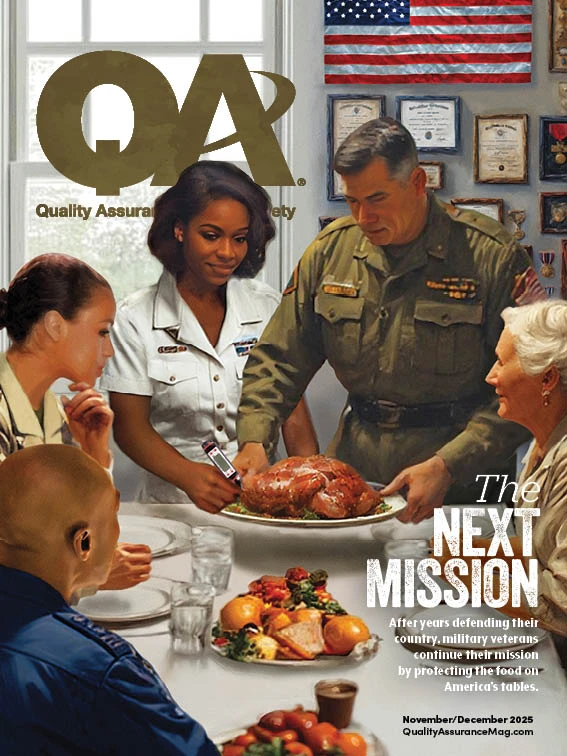
Explore the November/December 2025 Issue
Check out more from this issue and find your next story to read.
Latest from Quality Assurance & Food Safety
- USDA Terminates Paper and Packaging Research and Promotion Program
- ASI Unveils New Global Identity as Kiwa ASI
- FDA and Partners Release Findings from California Longitudinal Study
- Director General of IICA and Senior USDA Officials Meet to Advance Shared Agenda
- EFSA and FAO Sign Memorandum of Understanding
- Ben Miller Breaks Down Federal Cuts, State Bans and Traceability Delays
- Michigan Officials Warn Recalled ByHeart Infant Formula Remains on Store Shelves
- Puratos USA to Launch First Professional Chocolate Product with Cultured Cocoa