Editor's Note: This article originally appeared in the January/February 2026 print edition of QA magazine under the headline “What's Past is Prologue.”
Fifteen years is a long time.
In January 2011, smartphones were still more novelty than necessity. Streaming meant waiting for a movie to buffer. Some of us were refreshing Twitter, but social media hadn’t yet taken over how most people learned breaking news. Instagram was brand new. Adele’s “21” had just been released, but Beyoncé hadn’t yet given us “Lemonade.” Artificial intelligence certainly wasn’t helping us analyze supply chains.
That same month, the Food Safety Modernization Act (FSMA) was signed into law by Barack Obama — a moment that would reshape how food is regulated, produced and protected in the United States.
At the time, I was a fledgling journalist heading into my second semester of college. Food safety wasn’t on my radar yet. But for regulators, public health advocates and industry leaders, FSMA represented something enormous: a fundamental shift from reacting to foodborne illness outbreaks to preventing them in the first place.
It’s hard to overstate how ambitious that idea was in 2011.
FSMA called for new rules, new inspection models, new training requirements and a new way of thinking about risk. It asked regulators and industry to change not just what they did, but how they thought.
Fifteen years later, the food system looks very different. E-commerce, globalization, regulatory complexity and emerging technologies have added layers of nuance that no one could fully anticipate. And while FSMA is no longer new, it’s also not finished.
That tension — between progress and growing pains — is at the heart of our cover package, which starts on page 10.
In our opening feature, we revisit the early days of the law through the voices of those who helped shape it — the policymakers, regulators and advocates who navigated years of rulemaking, education and implementation to turn an ambitious vision into something workable.
In part two, we examine what happened next: how training and preventive thinking took hold, while inspections, enforcement, information-sharing and resources sometimes struggled to keep pace. It’s an honest look at where FSMA works — and where it still has room for improvement.
In our final feature, we turn to the future. Traceability was one of FSMA’s boldest promises — and one of its slowest to materialize. As compliance timelines shift and technology races ahead, we explore what FSMA’s traceability rule is truly meant to accomplish, and whether the industry is ready for what comes next.
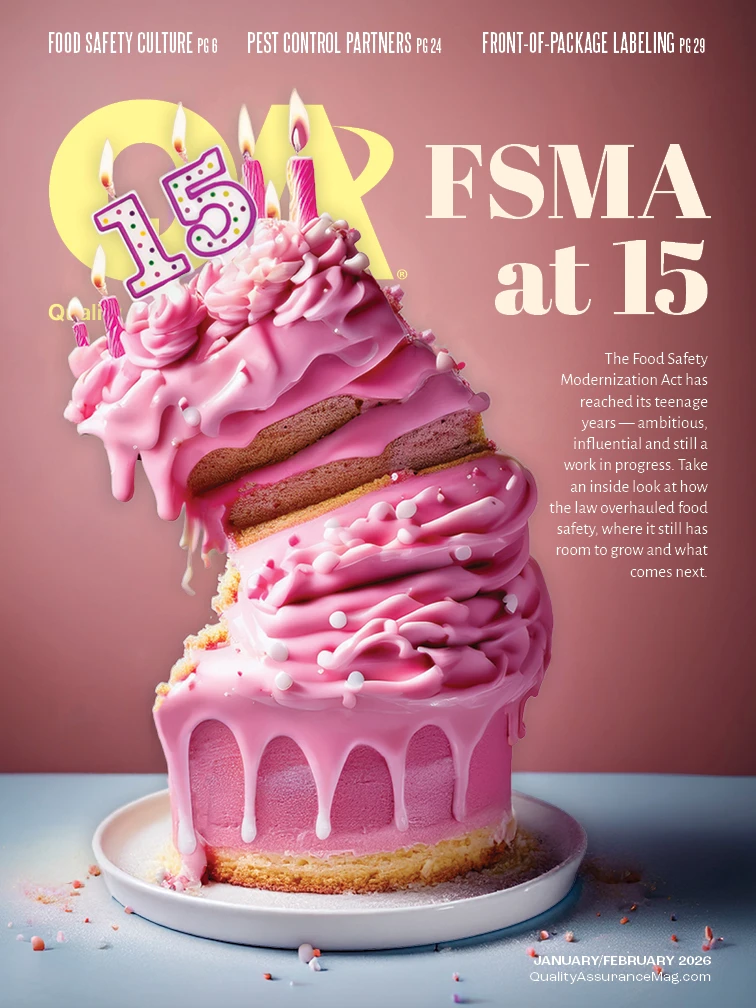
A lot can change in 15 years. Careers evolve. Technologies emerge. Systems mature, sometimes unevenly. FSMA has reached its teenage years, leaving behind its early promise and confronting the difficult work of follow-through. Its story is still being written, and the decisions made now will define its next chapter.
Explore the January/February 2026 Issue
Check out more from this issue and find your next story to read.
Latest from Quality Assurance & Food Safety
- Rep. DeLauro, Sen. Casey Introduce Infant Formula Made in America Act
- FDA Releases the CORE 2024 Annual Report
- FSIS Shares Lessons Learned from Listeria Outbreak Linked to Meat and Poultry
- Vitsab Showcases Freshtag Time-Temperature Monitoring Labels at Seafood Processing North America 2026
- USDA Proposes to Delay Effective Date of Poultry Grower Payment Systems Final Rule
- FDA Withdraws COVID-Era FSMA Guidance
- FDA Investigates Raw Cheese E. Coli Outbreak as Manufacturer Declines Recall
- USDA NIFA Launches Rapid Response Grants to Combat Emerging Agricultural Threats