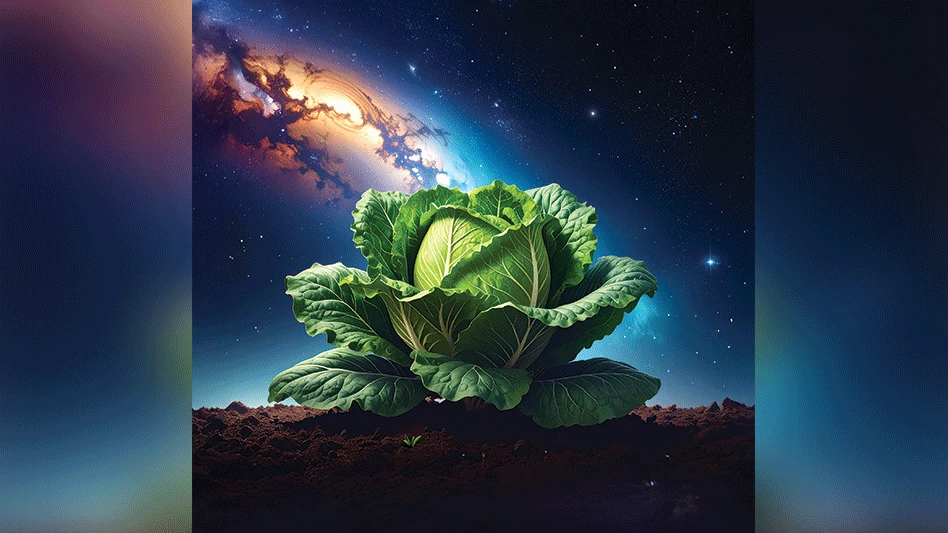
Generated with Adobe Firefly
Innovations developed for space travel are finding new life on Earth — this time, in food safety and agriculture.
Growing lettuce on the International Space Station (ISS) might not seem connected to applying food-safe coatings in a produce packing house, but the two share a surprising technological link. When NASA engineers embarked on the challenge of growing plants in the microgravity environment of space, they couldn’t have anticipated that their innovations would one day revolutionize food disinfection practices on Earth. Yet the quest to nourish astronauts aboard the ISS led to electrostatic spraying technology that now helps food manufacturers improve post-harvest food safety and support sustainability efforts.
What began as a solution to help plants grow in zero gravity has since evolved into a high-precision tool for delivering protective treatments to fruits, vegetables and even meat. By adapting a spray nozzle originally used in food manufacturing, NASA scientists — working in collaboration with Electrostatic Spraying Systems (ESS), a company based in Georgia — created a lightweight, water-saving system that is finding new purpose in pre- and post-harvest food processing.
Read on to learn how the electrostatic nozzle benefits Earth’s growers by reducing water and boosting sustainability.
ROOTS OF ELECTROSTATIC SPRAYING.
Long before this nozzle made its way into space, it was making waves in poultry. Bruce Whiting, owner of ESS, has worked with the University of Georgia for more than 25 years to address food safety concerns in poultry processing.
“We needed a way to disinfect deep within the follicles of chicken skin,” Whiting said, “and simply spraying with traditional methods wasn’t doing the job.”

Once a bird is de-feathered, it’s left with thousands of tiny follicle holes — perfect hiding places for bacteria like Salmonella. Standard spray systems produced droplets that were too large to reach into those microscopic pores. But by breaking liquid into fine, electrostatically charged droplets — around 40 microns in size — his team was able to coat and penetrate those crevices far more effectively, significantly improving sanitation.
The ESS team manufactures a proprietary nozzle that uses air to shear liquid into tiny droplets — each one carrying an electric charge. This allowed the droplets to “wrap” around surfaces, improving coverage in hard-to-reach places. Soon, the technology expanded beyond food safety into agriculture, where farmers began using electrostatic spraying to apply pesticides and nutrients more efficiently to fruits and vegetables.
This precision means farmers use less pesticide or nutrient solution per acre, reducing chemical runoff that can harm surrounding ecosystems. It also cuts water consumption, a critical advantage as agricultural water use faces growing scrutiny.
By using charged droplets, electrostatic sprayers ensured more uniform coverage with less waste — both in chemicals and water. It was a win-win: better protection for crops and reduced environmental impact.
This same technology that helped farmers improve precision and sustainability on Earth would soon face an entirely new test — one that couldn’t rely on gravity at all.
NASA’S ZERO-GRAVITY PROBLEM.
Growing plants in space presented a different kind of challenge. On Earth, gravity naturally pulls water downward, allowing it to flow through soil and reach plant roots. But in the microgravity environment of space, water behaves very differently. It doesn’t fall or flow as expected. This means moisture can easily miss its target entirely, making it incredibly difficult to ensure plants get the consistent hydration they need.
“You can’t direct it easily like you can on Earth,” explained Hetal Miranda, technology transfer officer at NASA. “Water just beads up and drifts around, which can lead to plants drying out or roots getting flooded if water pools improperly. Without gravity, traditional watering methods don’t work.”
NASA needed a system that could deliver water and nutrients in a controlled way, with minimal waste and no reliance on gravity or bulky air pumps. The agency found its solution in ESS’s technology. The concept of charged droplets sticking to surfaces — even in odd positions — was exactly what NASA needed for space farming.

To meet NASA’s requirements for space flight — lightweight, efficient and low-resource — the nozzle was redesigned. Instead of using compressed air, it operated on liquid pressure alone, producing ultra-fine, electrically charged droplets that adhered to plant surfaces in microgravity. The team even took inspiration from fine misting systems used in amusement parks to create a simple, compact nozzle capable of functioning in zero gravity.
HOW IT WORKS: A NONTECHNICAL LOOK.
Imagine rubbing a balloon on your head and sticking it to a wall. That’s how electrostatic spraying works. The droplets get a tiny electric charge that makes them cling to surfaces instead of falling off or floating away.
“We put an electric charge on each tiny droplet as it leaves the nozzle,” said Whiting. “Evenly charged droplets want to separate and stick to nearby surfaces — wrapping around leaves, fruit or meat to coat all sides evenly, even hard-to-reach spots.”
The nozzle breaks one droplet into hundreds of tiny ones, increasing coverage and reducing the amount of liquid needed. This saves water, chemicals and energy.
SPACE FARMING, EARTH BENEFITS.
NASA’s interest in plant growth goes beyond a salad in space. Food production is a core component of long-term space missions, particularly those to the moon or Mars. Building self-sustaining, low-resource systems is essential for survival — and the lessons learned in space can directly benefit Earth-based systems as well.
As far back as 1964, NASA officials were already thinking about this.
“We may develop boosters and guidance systems,” said Raymond Bisplinghoff, NASA’s associate administrator for advanced research and technology at the time, “but unless we can at the same time sustain life in space, we cannot have a manned space flight program.”
That perspective has only grown more relevant as NASA and private space partners prepare for future missions. With limited access to water and nutrients, the efficiency of spray systems like this one is critical for supporting crops in controlled environments.

BACK TO EARTH.
After testing and refining the nozzle for space, NASA reconnected with ESS to explore whether the same design could benefit food producers and farmers on Earth. The answer was a clear yes.
The updated nozzle, originally engineered to meet strict size, weight and resource limits of space missions, is now widely used in post-harvest agricultural spraying. In packing houses, where fruits and vegetables are cleaned and prepared for shipment, the nozzle delivers protective solutions such as antimicrobials and coatings with precision and minimal water use. This reduces waste and ensures even coverage, which helps extend shelf life and prevent contamination from harmful microbes like Salmonella and Listeria.
Beyond packing houses, ESS’s original electrostatic sprayers remain a staple for in-field applications. Farmers use them to spray strawberries, melons, leafy greens and other crops with nutrients, pesticides and fungicides more efficiently. The charged droplets wrap around leaves and fruit, reaching small crevices where pests or pathogens can hide, improving the effectiveness of treatments while reducing the total volume of chemicals needed.
The electrostatic nozzle benefits food safety by better targeting microbes and pests and also supports sustainability efforts by cutting water use and chemical runoff.
“The core idea is the same,” said Whiting. “Tiny electrostatically charged droplets just do the job better — whether it’s in orbit or in a strawberry field.”
By helping farmers and food processors use fewer resources while maintaining high safety standards, this innovation plays a small but important role in creating a more sustainable food system here on Earth.
A MORE SUSTAINABLE SPRAY.
Efficiency is at the heart of both space farming and Earth-based agriculture, where every drop counts. With climate change intensifying droughts and pushing water scarcity into the spotlight, farmers must find smarter ways to protect crops while using less water and chemicals.
“By improving coverage and adhesion, we not only reduce waste but enhance the efficacy of every spray,” said Whiting. “That’s a win for crop health and sustainability goals.”
In food manufacturing, this precision opens the door to new, advanced safety measures — like spraying bacteriophages, natural viruses that target harmful bacteria. Bacteriophage treatments are highly effective but traditionally very expensive, partly due to the large volumes needed for conventional spraying methods. Using electrostatic nozzles to deliver these tiny, charged droplets means processors can apply bacteriophages more efficiently, reducing costs and increasing the feasibility of adopting this cutting-edge food safety technology.
By enabling more uniform application, the technology helps extend shelf life and reduce food waste — another important piece of sustainable food systems. From outer space to Earth’s farms and food plants, the electrostatic spray nozzle shows how tech designed for extreme environments can inspire practical, scalable solutions that meet agriculture’s toughest challenges.
LOOKING AHEAD.
This isn’t just a story about space exploration or farming. It’s a story about how good science travels — how solving a challenge in one environment can spark a breakthrough in another. From poultry plants to the ISS and now to commercial farms, the journey of the electrostatic spray nozzle shows what’s possible when innovation crosses boundaries. In an era where we need every tool to make food production more sustainable, a little space tech might just go a long way.
Explore the July/August 2025 Issue
Check out more from this issue and find your next story to read.
Latest from Quality Assurance & Food Safety
- Ajinomoto Foods Recalls Products Due to Potential Glass Contamination
- Grubhub Introduces Drone-Powered Food Delivery Program
- FSIS Releases 2025 Foodborne Illness Outbreak Investigations Report
- EWG Analysis Flags 111 Ingredients Added to Foods Through GRAS
- FDA Releases Risk Assessment of Foodborne Illness from Produce with Untreated BSAAO
- Catalyst Food Leaders Announces 2026 Virtual Leadership Summit
- FDA to Hold Public Meeting on Dietary Supplements
- USDA Partners with Army Corps on New World Screwworm Sterile Fly Production Facility