Generated with Adobe Firefly
Change is a constant — especially within the food and beverage industry. But lately, it can feel like those changes are coming faster and hitting harder. From massive layoffs and funding shifts to questions around inspections and how compliance is measured, food safety professionals are navigating unfamiliar territory.
You may be asked — or have to ask others — to do more with less and to guide teams through cultural, structural and technological transformations. So, there’s a chance you’ve been hearing the term “change management” more often.
In an industry defined by constant disruption, knowing what change management is in the food and beverage industry has become a critical skill for survival and success.
“At its most basic level, change management is a structured approach to transitioning individuals, teams and organizations from a current state to a future state,” said Rochelly Serrano, founder of Your Pathfinder Life Coach, an executive leadership coaching firm. “It involves the process of tools, techniques and how you manage change to achieve the desired result that you’re looking for.”
Many companies treat change management as little more than a checklist: Update an SOP, revise a process, move people into new roles, and call it done. That’s a mistake, said Tia Glave, cofounder of Catalyst Food Leaders, a leadership coaching company focused on the food industry.

“For organizations who do change management well, people are a part of that process,” said Glave. “Leaders think about how they’re going to communicate with people and how they’re going to introduce change.”
It’s been proven time and time again that successful change happens when companies support their people and employees feel like they can place trust in their leaders.
“Everybody’s trying to change, but many companies aren’t focused on how they help people navigate through it,” said Jill Stuber, cofounder of Catalyst Food Leaders. “That means that people can experience change overload. If companies can’t recognize when that happens and be able to pause or support their employees differently, it can create quiet quitters.”
While change can be scary and overwhelming, it also can be an opportunity. We talk to the experts about what effective change management looks like in the food industry and why focusing on people — with empathy, compassion and trust — may be the most important change of all.
CHANGE MANAGEMENT IN FOOD SAFETY.
Food safety should be woven into the fabric of every change in a food and beverage organization, said Stuber, who has more than two decades of experience in food safety and quality at companies like Land O’Lakes, Gold’n Plump and Arctic Cold Storage and Processing.
Before leaders can embed food safety into companywide initiatives, they must first understand what change management is in the food and beverage industry and how it connects to their broader organizational goals.
“When you think about the top leadership in organizations and the musical chairs that happens, it’s an opportunity to think about how food safety does or doesn’t show up,” Stuber said. “How top leaders across business functions embody food safety makes a difference to food safety culture. That’s why we need strong food safety leaders at our highest levels who think strategically about the business to navigate conversations with other business leaders. Do they walk the talk? Do they really value food safety? And what does that look like?”
Ideally, a company’s leader will have direct accountability to food safety. Glave, who has worked in food safety and quality at companies like General Mills and Milk Bar, said that during an organizational restructuring, food safety professionals should intentionally check for one key signal: “What does the reporting structure for food safety look like now? Is there still direct accountability to the CEO?”
When food safety is buried too deep in a company’s structure, risks increase and accountability can become diluted. But food safety leadership isn’t about power and visibility. It’s collaborating and mitigating risks. While technical knowledge is important, it’s human skills that bridge across functions to create cohesive systems. It’s about the process — and thinking about how certain aspects like GFSI certification and environmental swabbing will be conducted.
“Once you have annotated and documented your process, it’s easier to duplicate,” said Serrano, former senior director of quality assurance at Niagara Bottling. “Ultimately, this process creates continuity. You can follow the process and determine at what point something didn’t result in the right outcome.”
Documenting your food safety process and having it being followed by all involved supports consistency, root-cause analysis and better future decision-making — all things that become critical when there’s a problem within that process. Whether you’re part of a mom-and-pop company in a small manufacturing facility or working for a global food company at one of many locations, change management will come in handy.
“Relying on change management is pretty ubiquitous to a lot of other industries, like car, pharma and medical,” said Serrano. “The food industry has always been behind those other industries — and even the standards seem to be slightly different. But I think the food industry is going to catch up.”
HOW TO LEAD THROUGH CHANGE.
There are two kinds of changes: planned and unplanned. A planned change is proactive, rooted in strategy, foresight and clear goals. Leaders set the course, prepare their teams and execute steps with intention. On the other hand, an unplanned change is reactive. It comes from crisis, market shifts or unforeseen disruptions.
In both scenarios, the way leaders show up makes all the difference. It all starts by being an effective leader who understands that change impacts people — how they feel, how they work and how they view where they work.
Confusion, fear, resistance and even disengagement can happen, especially when an employee feels unheard or blindsided.
“If you’re working through a change and it didn’t go well, it’s not your employees — it’s you. It’s you as a leader,” stressed Glave. “You didn’t prepare them, and you definitely weren’t prepared for the outcome.”
Stuber agreed, referencing a quote from leadership expert John C. Maxwell: “If behaviors aren’t changing, you aren’t leading.”
“Often, leaders become frustrated that employees aren’t doing what they need them to do,” said Stuber. “That’s a sign to pause and observe what’s happening to cause the frustration — and help work through it versus bulldoze through it.”
Operating in a silo never works out well. Glave offered an example of an operations team that kept mispackaging products, though they were following the process that had been in place. Even after frequent training, the mistake kept happening. It wasn’t until Glave took a step back and actually talked to the team that she uncovered the real issue.
“Sometimes, we get so focused on the documentation we need to update or what process is broken that we completely forget it’s about people,” Glave said. “We can miss that people are the critical aspect of the change, not the process.”
Listening is critical, and while inclusion might feel messy, it builds confidence and dependability. Transparency is also key.
“To minimize the anxiety that comes with change, leaders need to be as transparent as they can be,” said Serrano. “The more you talk to an individual, the more transparent you become. The more you allow them to be part of the journey, the more they learn to cope with the changes.”
That doesn’t mean you have to tell your employees everything: “It’s OK to tell people that there is information that you can’t share yet,” said Glave. “That’s better than avoiding people or telling them something that’s just not true.”
The end goal is building trust — and that happens by forming connections, having conversations and offering clarity.
“As an employee, one of the worst things that you may feel is when you feel like you’re not getting the whole story — that there’s more happening that you just don’t know about,” said Stuber.
HOW TO EMBRACE CHANGE.
When there’s a whirlwind of change, it can be easy to feel swept away amid the chaos and uncertainty. But there are strategies employees can use to help them feel grounded.
Stuber said if you’re feeling overwhelmed and doubtful, there is one question she likes to ask: What can I actually control?
“There are things that happen around us, things that happen to us, things that happen for us — and when you can start discerning between those things, it helps you center your energy on the things that you have more control over,” she said. “You have more agency over how you show up every day and where you choose to put your energy.”
While you may not be able to control federal regulations or research funding, you can control how you embody your company’s values and how you advocate for food safety. And once you have a good sense of the situation, Glave encourages you to speak up if you feel comfortable doing so.
“In company cultures that have a strong sense of trust, you hear more people speaking up and saying, ‘I don’t know if that’ll work, and this is why,’” she said.
Take note of how colleagues are responding to change. Find someone who models the type of behavior or attitude you’d like to have when faced with upheaval.
“Tell them that you noticed they’re excelling under the circumstances,” said Serrano. “Then ask them to share some of their tips on how they’re navigating the situation. Don’t isolate yourself or surround yourself with negative coworkers. If you want to change your perception or your own inner voice, learn from others who are doing it well.”
To that point, Serrano stressed the importance of learning from other food and beverage companies, adding that she’s benefited from sitting down with her counterparts from other businesses.
“You can learn from the challenges and opportunities they’ve had to deal with — and many times, you’re both going through a similar situation,” she said. “It can be helpful to see it from a different lens. Food safety is not a competitive advantage — there’s a lot of power in learning from other people.”
Understanding what change management is in the food and beverage industry is not just a trendy leadership skill — it’s a necessity for resilient, safe and people-centered organizations.
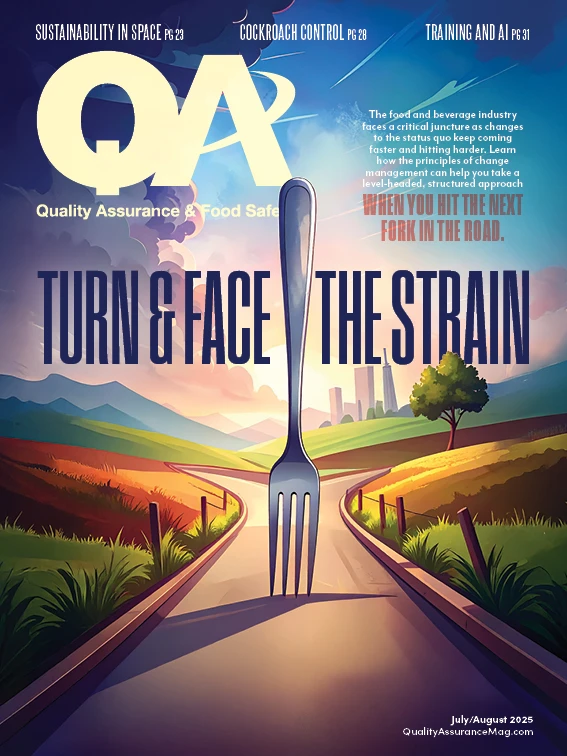
Explore the July/August 2025 Issue
Check out more from this issue and find your next story to read.
Latest from Quality Assurance & Food Safety
- Ajinomoto Foods Recalls Products Due to Potential Glass Contamination
- Grubhub Introduces Drone-Powered Food Delivery Program
- FSIS Releases 2025 Foodborne Illness Outbreak Investigations Report
- EWG Analysis Flags 111 Ingredients Added to Foods Through GRAS
- FDA Releases Risk Assessment of Foodborne Illness from Produce with Untreated BSAAO
- Catalyst Food Leaders Announces 2026 Virtual Leadership Summit
- FDA to Hold Public Meeting on Dietary Supplements
- USDA Partners with Army Corps on New World Screwworm Sterile Fly Production Facility