Editor's Note: This article originally appeared in the November/December 2025 print edition of QA magazine under the headline “Defeat the Dirty Dozen.”
In the modern food manufacturing and storage industry, the presence of stored product pests (SPPs) is not just a nuisance. It’s a direct threat to quality assurance, brand integrity and compliance with third-party audits. Facilities that store, process or distribute dry goods must maintain zero tolerance for infestation. Whether inspected by an auditor, a regulatory agency or a client’s quality assurance team, pest management performance is scrutinized as a reflection of the company’s overall commitment to food safety and Good Manufacturing Practices (GMPs).
Both pest management professionals (PMPs) and facility food safety and quality assurance teams share equal responsibility in maintaining a pest-free environment. The best response to stored product pest activity in food facilities requires consistent documentation, proactive prevention and a deep understanding of the key offenders — otherwise known as the dirty dozen of stored product pests.
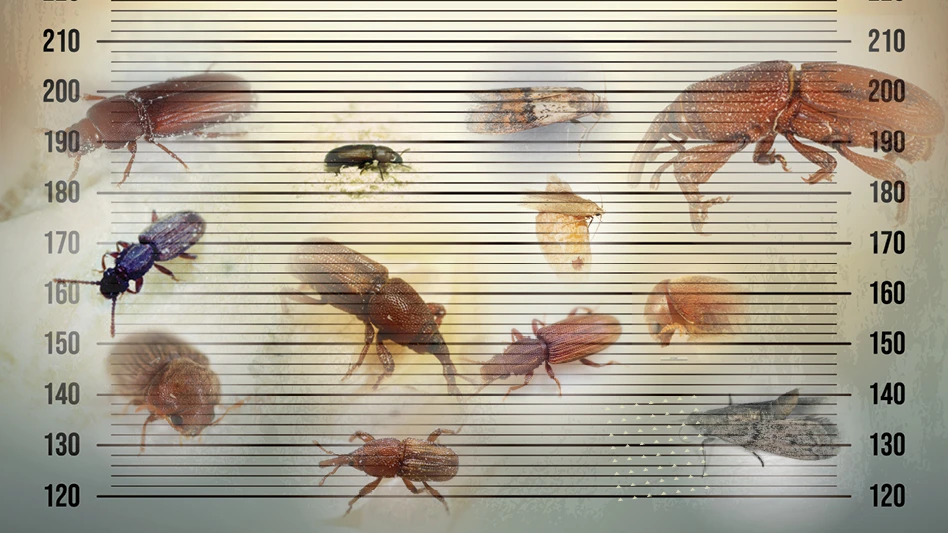
THE DIRTY DOZEN.
The “dirty dozen” refers to 12 of the most common and destructive SPP species affecting food and grain facilities. They are divided between insects that infest whole kernels (external feeders) and those that develop inside grains (internal feeders).
External feeders include:
- Red flour beetle (Tribolium castaneum)
- Confused flour beetle (Tribolium confusum)
- Sawtoothed grain beetle (Oryzaephilus surinamensis)
- Merchant grain beetle (Oryzaephilus mercator)
- Cigarette beetle (Lasioderma serricorne)
- Drugstore beetle (Stegobium paniceum)
Internal feeders include:
- Rice weevil (Sitophilus oryzae)
- Granary weevil (Sitophilus granarius)
- Maize weevil (Sitophilus zeamais)
- Angoumois grain moth (Sitotroga cerealella)
- Indianmeal moth (Plodia interpunctella)
- Mediterranean flour moth (Ephestia kuehniella)
Each species attacks a variety of stored foods, including flour, grains, cereals, dried fruit, tobacco, chocolate, pet food and spices. These insects thrive in processing residues, dust accumulations and hidden voids, making thorough sanitation and monitoring crucial to long-term prevention.

ARE YOU AUDIT READY?
From a quality assurance standpoint, auditors want to see evidence that a facility not only has a pest management plan, but that it is implemented, verified and continuously improved.
During an audit (such as those under BRC, SQF, AIB or ISO standards), expect detailed questions and document reviews in the following areas:
- Written IPM program. Your facility should have a documented Integrated Pest Management (IPM) plan outlining monitoring, thresholds, corrective actions and responsibilities.
- Pest sighting logs. Every sighting or capture should be recorded, investigated and followed up with corrective actions.
- Device maps and trending. Each monitoring device (pheromone trap, rodent station, insect light trap, etc.) must be numbered, mapped and serviced per schedule. Trend analysis is key to continuous improvement.
- Corrective action reports. Auditors look for root cause analysis and documented follow-up, not just cleaning or re-baiting.
- Service records and communication. The PMP should leave detailed reports after each visit, and the facility should demonstrate ongoing collaboration.
Both the PMP and the QA team should be audit-ready every day, not just the week before inspection. This means maintaining current documentation, verifying devices and keeping sanitation at a consistently high level.
THE PMP’s ROLE.
A professional pest partner should act as a strategic extension of a facility’s QA team. Their duties go beyond control to include coaching facility staff, trend analysis and identifying conducive conditions before an infestation develops.
Key PMP responsibilities include:
- Monitoring and identification. Using pheromone traps, visual inspections and stored product sampling to detect activity early.
- Data management. Using digital inspection software or cloud-based dashboards that allow facilities to view real-time trap counts, heat maps and service notes.
- Communication and training. Explaining findings, recommending structural or sanitation improvements and helping facility staff understand the pest life cycle.
- Regulatory knowledge. Staying current with FSMA, GFSI and state food safety regulations to ensure program compliance.
An audit-ready PMP provides transparency, reliability and traceability — core values that reflect well on the facility’s overall food safety culture.
THE FSQA TEAM’S ROLE.
While the PMP designs and monitors the IPM program, food facility staff are on-site daily and play the most critical role in prevention. Facility managers and QA leaders should ensure the following core practices are embedded into operations for the best response to stored product pest activity in food facilities:
- Sanitation. Clean spills immediately, remove dust accumulation on ledges and equipment and schedule deep cleanings of hard-to-reach areas.
- Inventory management. Follow FIFO (“first in, first out”) and track expiration dates to prevent long-term storage of vulnerable products.
- Building maintenance. Seal wall penetrations, maintain door sweeps, repair screens and close gaps under dock doors.
- Inspection of incoming goods: Require suppliers to provide pest-free certifications and inspect every incoming shipment for contamination or webbing.
- Environmental conditions. Keep humidity and temperature in check, because many stored product pests thrive in warm, humid environments.
By integrating pest awareness into routine QA checks and employee training, facilities can prevent infestations before they start and demonstrate strong food safety culture to auditors.

IPM FOR STORED PRODUCT PESTS.
An IPM program provides a proactive, data-driven framework to prevent, monitor and control SPPs using minimal pesticide intervention.
Core IPM elements include:
- Exclusion. Prevent pest entry through physical barriers and good building maintenance.
- Sanitation. Eliminate food residues that sustain insect populations.
- Monitoring. Use pheromone traps, light traps, pitfall traps and sampling of raw materials.
- Thresholds. Establish acceptable limits for activity before escalation (for example, number of insects per trap per week).
- Control methods. When necessary, use targeted treatments such as residual dusts (e.g., silica or pyrethrins), fogging, heat treatments or fumigation under controlled and documented conditions.
- Documentation and review. Maintain service logs, device maps and trending reports for auditor review.
When executed properly, IPM not only satisfies audit criteria but also reduces product loss, chemical usage and long-term pest risk.
TECHNOLOGY AND DIGITAL TOOLS.
Modern pest management programs increasingly rely on data and connectivity. Advancements in digital monitoring allow both PMPs and customers to stay informed in real time.
Key technology tools include:
- Insect monitoring. Wireless sensors and pheromone trap monitors send instant alerts when pests are detected, improving response time.
- Cloud-based reporting systems. Digital dashboards store inspection data, trends and photos accessible to auditors and QA staff at any time.
- Barcoded device tracking. Ensures all traps and monitors are serviced consistently and traceably.
- Data analytics. AI-based systems analyze pest trends seasonally and by location, guiding targeted interventions.
In an audit, these systems demonstrate transparency, accountability and a modern commitment to continuous improvement.

WHERE QA MEETS PEST CONTROL.
Pest control is not a standalone service. It’s a core quality assurance function.
Auditors view pest activity as a symptom of broader failures in sanitation, maintenance or oversight. Therefore, QA teams and pest professionals must collaborate closely, reviewing pest data alongside other quality metrics such as foreign material complaints, temperature logs and housekeeping scores.
Joint walkthroughs between QA and pest technicians should occur regularly, with emphasis on trend review and root cause prevention rather than reactive treatments. This partnership reinforces a proactive mindset and ensures audit readiness year-round.
AUDIT-READY EVERY DAY.
Stored product pests present a serious risk to food safety and product quality, but through collaboration, documentation and technology, they can be effectively managed. Facilities that combine robust IPM, continuous monitoring and shared accountability between the FSQA team and pest management professional don’t just pass audits — they build lasting consumer trust.
The best response to stored product pest activity in food facilities includes understanding the behaviors of the dirty dozen, maintaining meticulous records and adopting data-driven pest management technologies. By following these guidelines, companies can ensure that every inspection, scheduled or a surprise, confirms what they already know: That their facility is clean, compliant and committed to excellence.

Explore the November/December 2025 Issue
Check out more from this issue and find your next story to read.
Latest from Quality Assurance & Food Safety
- USDA Terminates Paper and Packaging Research and Promotion Program
- ASI Unveils New Global Identity as Kiwa ASI
- FDA and Partners Release Findings from California Longitudinal Study
- Director General of IICA and Senior USDA Officials Meet to Advance Shared Agenda
- EFSA and FAO Sign Memorandum of Understanding
- Ben Miller Breaks Down Federal Cuts, State Bans and Traceability Delays
- Michigan Officials Warn Recalled ByHeart Infant Formula Remains on Store Shelves
- Puratos USA to Launch First Professional Chocolate Product with Cultured Cocoa