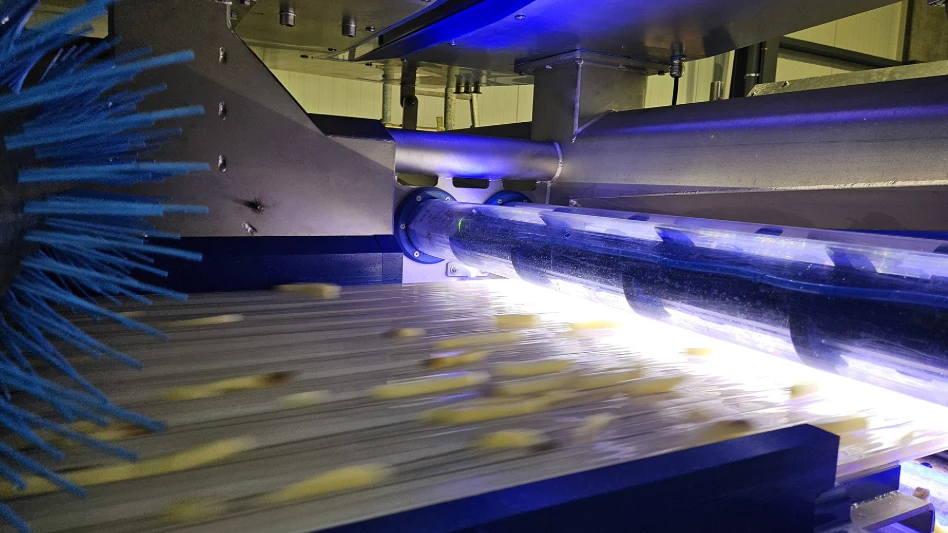
Compressed air is commonly used in the food industry as a conveyor, as a power source for equipment and valves, to open packaging, and to clean the lines. Compressed air is commonly used in the food industry as a conveyor, as a power source for equipment and valves, to open packaging, and to clean the lines. |
What item can be used to clean equipment, can be an equipment power source, and can even be directly injected into the product, but cannot be seen? If you guessed air, you solved the riddle!
Air is often overlooked as a food plant hazard because it is all around us, yet invisible. But, have you considered how air could potentially contaminate your products or cause injury to your employees? Compressed air is commonly used in the food industry as a conveyor, as a power source for equipment and valves, to open packaging, and to clean the lines. In some cases, it is even used as direct injection into the product. But, if not managed properly, air can present a potential source for microbiological, chemical, or physical contamination.
In 1991, the International Standards Organization (ISO) established ISO 8573, which provides compressed-air quality standards, encompassing the equipment selection and design and monitoring the resulting quality (test methods). A compressed air system is composed of multiple components that need to be designed, installed, maintained, and monitored by knowledgeable individuals to ensure the air does not provide a potential contamination source to your product.
Compressor Placement
The quality of the intake air has a direct impact on the functionality of the system. The best, first step of the system is the placement of the compressor. Since compressors are loud, they are typically placed in a back room. Ensure that this area is clean and screened to keep out insects, and that chemicals or other sources of fumes are not stored there. Also, reduce or vent other motors being exhausted in the area to limit the concern of hydrocarbons from the exhaust fumes.
Pre-compressor Filter
Typically, there is a 40 micron filter at the compressor’s air intake. This first filter’s purpose is to extend the life of the compressor and downstream filters.
 Compressor
An air compressor is essentially a huge vacuum cleaner—sucking in everything within its immediate environment. The air molecules are then compressed to achieve the desired pressure.
This generates a great deal of heat, so various methods are used to cool the compressor, including oil, water, and air. Oil is not an appropriate cooling method for compressed air that is used for direct or indirect product contact use. All compressors, even “oil-free” varieties, use lubricants; however, the lubrication areas are sealed to prevent leaks into the compression chamber.
Post-Compressor Filter
During compression, moisture from the air and oil from the hydrocarbons (fumes from equipment) are also compressed, causing droplets to form. These droplets need to be removed. Oil droplets are typically removed by a coalescent filter. A compressed-air coalescent filter is composed of tightly packed, fine-glass fibers. The air passing through the fibers causes droplets to condense and drip to the bottom of the filter house. Check your equipment manufacturer’s recommendations; however, the following sequence of filters is typically installed to improve air quality and increase the life of the coalescent filter.
- A general filter which removes large particles of 30 to 40 microns
- A second filter which is effective in removing down to five microns
- The coalescent filter (depending on the unit purchased) which filters oil down to 0.01 microns
- An optional activated carbon filter which is commonly used to absorb or remove trace odors if the compressed air is injected into the product.
The filters can plug (reducing air flow) or channel (bypass the filtration), so each needs to be included in the preventive maintenance program. In addition, the coalescent filter housing/trap needs to be routinely monitored and emptied to prevent the condensed oil and water from re-entering the air stream. Finally, the activated charcoal filter (carbon that is activated with oxygen) needs to be periodically replaced.
A desiccant dryer is the method most commonly used to remove the compressed water droplets. Desiccant dryers with automatic condensate drains are necessary after the coalescent filter to remove this condensation.
Piping
The typical piping used to convey compressed air is black metal, which is forged steel pipe that has a black oxide scale on its surface. There are some concerns with the black steel material and the method of connecting the pipes (typically threaded with soft cast iron fittings). These fixtures are subject to rust and corrosion, presenting the potential of both physical hazards and microbiological harborage sites. If the compressed air is injected directly into the product or used on product contact surfaces, additional air treatment and a different pipe construction is indicated.
End-point Filtration
Before compressed air is injected directly into product or used on product contact surfaces, it should have additional filtration to remove any potential contamination that was introduced by the piping. After this filtration, the delivery piping should be constructed of 316-stainless steel.
Micron filtration is based on the use of the compressed air. Again, refer to the industry or the ISO standard for the filtration that is appropriate for your use. The maximum micron filter outlined in the AIB Consolidated Standards for Inspection is five microns for non-microbiologically sensitive materials. However, based on the product produced and use of the air, you may need to go smaller.
Monitoring the Air Quality
The ISO standard clearly outlines how to test the filtration efficiency of your system; however, it does not encompass testing end-point use for micro analysis. After the end-point use filter, a sample cock should be installed to collect samples of the air. There are a multitude of sampling and testing techniques that can be used with compressed air.
For more detail on how to collect and test compressed air, conduct an Internet search for “compressed air microbiological sampling.” There are a number of well-written articles on this topic. Another excellent resource is the British Compressed Air Society, which has an “Industry Code of Practices.” Its website is www.bcas.org.uk.
Employee Safety
Compressed air can be a significant employee safety concern. High-pressure, compressed air can and has punctured and ripped skin and muscle. Though rare, air that is injected into the blood stream can cause an embolism (air bubble in the veins).
Specific information on the use of compressed air for cleaning purposes is found in OSHA regulation 29 CFR 1910. It requires that compressed air used for cleaning purposes must be reduced to less than 30 psi and only used with effective chip guarding and personal protective equipment to protect the operator and other employees from the hazards of the release of compressed air and flying debris. This is important to protect the eyes and other body parts, such as the respiratory system, from becoming damaged as a result of improper use. This requirement is also necessary to prevent a back pressure buildup in case the nozzle is obstructed.
Include these employee safety issues in your compressed-air program:
- Reduce pressure to 30 psi if the nozzle is dead-ended (such as a compressed air wand, where someone can put a hand on the end of the nozzle).
- Implement procedures that include eye protection, consideration of other employees and activities in the area, and no tolerance for playing with compressed air.
- Do not use compressed air to clean uniforms or people.
OSHA has online diagrams of a few acceptable means of reducing the pressure to 30 psi. These are available at www.osha.gov/OshDoc/Directive_attach/STD_1-13_1_STD_01-13-001-Attachment.pdf.
Summary
A compressed air system is comprised of multiple components that need to be designed, maintained, and monitored to ensure the air does not become a source of product contamination.
Latest from Quality Assurance & Food Safety
- FDA Releases Produce Regulatory Program Standards
- Invest in People or Risk the System: Darin Detwiler and Catalyst Food Leaders on Building Real Food Safety Culture
- USDA Proposes Increasing Poultry, Pork Line Speeds
- FDA Releases New Traceability Rule Guidance
- TraceGains and iFoodDS Extend Strategic Alliance
- bioMérieux Launches New Platform for Spoiler Risk Management
- SafetyChain Receives SOC 2 Type 2 Certification
- Puratos Acquires Pennsylvania-Based Vör Foods