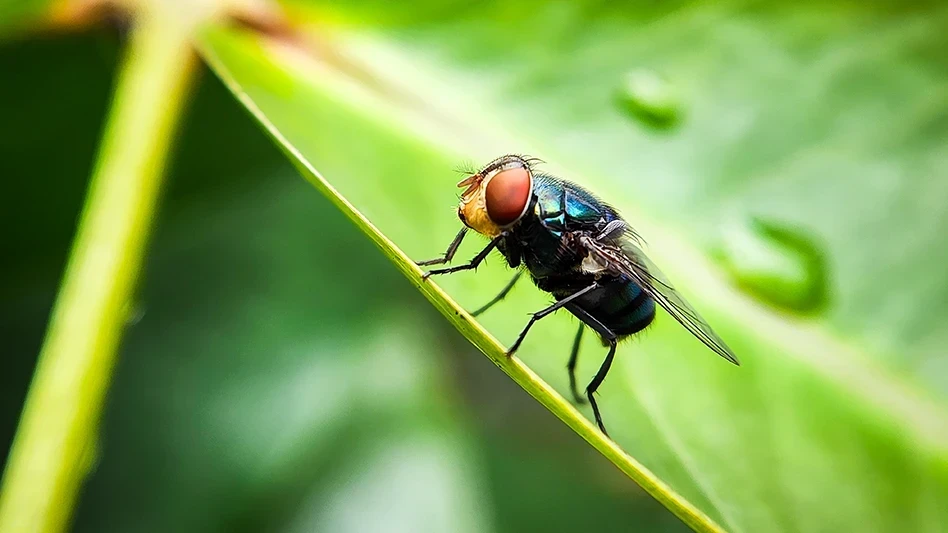
If you see a small one, it probably originated inside your building; but if it is large, it most likely came in from the outside. Whether that pesty insect flying around your head is a small, barely visible drain fly or a large filthy house fly, it’s a threat to the food safety within your plant and needs to be controlled.
"There are a dozen or so common species of flies that can be found in food plants," says Mark Sheperdigian, vice president of technical services, Rose Pest Solutions, Troy, Mich. But because of similar habits and control strategies, the species are usually defined by two groupings — small flies, such as the phorid, drain and vinegar fly which live and breed inside buildings and are generally little noticed until a population arises; and large flies, including the house and blow flies – those described by Sheperdigian as "the big, large buzzy flies that everyone can see." This group of pests, often found in food-processing plants, is also often termed "filth flies" because "most come from filth," he states, adding, "it is very unusual for them to breed inside, even in a large food plant."
1. Identification. "The number one thing before anything can be done is to identify the fly," said Richard Berman, director of technical services, Waltham Services, Waltham, Mass. Once you know what the fly is, you will be better able to discover its source, and control the problem. If, for example, you identified the tiny humpbacked insect as a phorid fly, you would know it originated inside the plant, and you should check for maintenance issues such as plumbing leaks. If, on the other hand, it is a large, buzzy blow fly, you will realize it has come in from outside and you should check for problems such as open doors, dirty trash areas and attractant lighting. There are a number of resources for fly identification, Berman says, including extension agencies, entomologists, local universities, Web sites, and, of course, your pest management technician. But however you seek to identify it, "make sure you get it identified," he says.
2. Sanitation. "Sanitation. Sanitation. Sanitation." This assertion made by both Berman and Zia Siddiqi, Orkin’s director of quality assurance, is affirmed by Sheperdigian: "It’s sanitation more than anything else," confirms its importance in fly prevention. "I can’t think of a situation where you have flies without some sort of underlying sanitation problem," Berman explains, particularly as it relates to the small interior flies. And, Siddiqi says, when there are sanitation issues, there is not much the pest control provider can do except educate their customers and provide recommendations on cleaning.
3. Maintenance. When assessing sanitation, a plant should also assess maintenance issues, as the one can result from the other. For example, deteriorated or missing caulking can cause a build-up of decaying organic matter which then attracts flies, particularly the small phorid fly. "This is not a sanitation problem, it is a maintenance problem," Sheperdigian says. Problems can also arise from issues such as plumbing leaks, which cause a build up of waste water and attract flies, Berman says. Older plants should pay particular attention to – and maintain – old cast-iron pipes that can, over time, get brittle and crack, causing the leaks. Regular checks should be made of pipe joints and fittings as well.
4. Trash. Sanitation also extends to trash areas, both interior and exterior, which are a chief attractant for flies. "You want to make sure that you are not growing [flies] yourself," Sheperdigian says, which means not only emptying the trash regularly, but also cleaning the area. In fact, trash areas are so important to fly control that in an article written for Copesan’s IPM Update newsletter, seven of Sheperdigian’s top 10 steps for ridding a facility of flies referred to trash handling. The steps included actions such as using liners in waste baskets; washing trash cans and dumpsters on a regular basis; taking trash directly to the dumpster or compactor – which are located as far from the facility as is practical and are emptied regularly; and checking for and removing fly-attractive material near the dumpster.
"How trash and garbage are handled is very important, especially in the warm weather," Siddiqi says. "It has to be a closed system." An open trash can or dumpster is an open invitation to flies, attracting them to your plant area, providing breeding grounds, then bringing them inside through doors, windows or other entry ways. Siddiqi recommends that trash be picked up twice a week during the summer months. This is because, under ideal summer conditions, a fly’s life cycle can be completed in seven days, so if trash is only picked up once a week, you are allowing a full life cycle to develop.
Regular inspection of external garbage areas also is critical. Check for, clean and fix problems such as leakage, water accumulation and clogged drains beneath pads. "That’s where you grow flies," Sheperdigian says. Internally, workers should regularly hose down walls when trash is taken out. Otherwise you are emptying the trash can, but not necessarily eliminating fly pupae.
One way to tell if filth flies originated inside a building or came from outside is the population scale. "If they all arrive on the same day by the dozens or hundreds. If one day you had none; the next day, you had dozens; the next even more. When that happens, it is an indication that you grew them," Sheperdigian says.
5. Doors. "Good old basic exclusion," such as shutting and screening doors is fundamental to fly control, he adds. However, this is not always as easy as one might think, particularly in food plants where a shut door generally means a locked door. Knowing this, workers slipping out a back door to smoke or take a break often prop the door open to enable re-entry, which, in turn, enables entry by flies. If you are unsure if or where workers are doing this in your plant, try Sheperdigian’s trick: From the roof of your building check the grounds in front of doors – a telltale sign of smokers will be the fantail shape of flicked cigarette butts fanning out from the door.
The doors in shipping and receiving areas are also common problem sites for plants. Where doors cannot be kept closed, barriers such as air curtains or strips should be installed. Also, check screened doors and windows regularly for holes or gaps and consider implementing a door-use policy, routing outside entry away from doors leading directly into the processing area – especially those near dumpsters.
6. Positive air pressure. Even with door-use policies, it is important that the plant have a well-maintained positive air-pressure system. "When I open the door, I want air going out, not sucking in," Siddiqi says. Otherwise, you literally will be pulling flies and other insects in from outside each time a door is opened.
7. Lighting. Exterior lights will attract flying insects to your plants. While the lighting can be directed toward the door for safety, the light itself should be located away from doors, either on poles located away from the building or 10- to 15-feet above the door.
8. Building Design. Air pressure and lighting are both examples of building designs that can have a major effect on fly control. If you are redesigning an area of your facility, or doing any sort of renovation or reconstruction, involve your pest management provider for recommendations. He or she can advise you, the designer, or the builder, in a number of areas so that you build pests out from the start.
9. Light traps. Insect light traps do catch flies that have entered your plant from the outside, so they are a good piece of the IPM plan, but their greater importance is as a monitoring tool to help in the identification of the fly and detection of the source. "The number one misconception is that this is a magic bullet," Siddiqi says. "It’s not." For example, he has known plants to purchase 10 traps to put around their buildings, expecting this to solve their fly problem. But if they don’t clean the trash area or shut the doors that are attracting flies, they are treating the symptom, not the cause.
10.Treatment. IPM is a program in which a number of methods are integrated into a single program to manage pests. Thus the program, at times and in accepted areas, may include pesticide treatments by a certified technician. Externally, this can include fly baits placed around the building, use of insect growth regulators, and spraying of common fly resting sites, such as walls and windows ledges. Internally, treatment by ULV fogging in areas for which the product is labeled and all safety precautions are followed can be effective to knock down existing flies. "It can be seen as a large chemical fly swatter," Sheperdigian says. "It will only affect those which are present, it won’t keep more from coming in."
Implementing these 10 tactics will take you a long way down the road toward controlling flies in and around your plant. But remember, no single tactic will serve to eliminate the flies until you find and eliminate their feeding and breeding site. Flies are actually a symptom of a problem, for which you need to find the root cause, Berman says. "There’s a reason why they’re there. You fix the reason, you eliminate the flies." QA

Explore the Summer 2006 Issue
Check out more from this issue and find your next story to read.
Latest from Quality Assurance & Food Safety
- FDA Releases Produce Regulatory Program Standards
- Invest in People or Risk the System: Darin Detwiler and Catalyst Food Leaders on Building Real Food Safety Culture
- USDA Proposes Increasing Poultry, Pork Line Speeds
- FDA Releases New Traceability Rule Guidance
- TraceGains and iFoodDS Extend Strategic Alliance
- bioMérieux Launches New Platform for Spoiler Risk Management
- SafetyChain Receives SOC 2 Type 2 Certification
- Puratos Acquires Pennsylvania-Based Vör Foods