When X-ray inspection systems appeared in the food industry about twenty years ago, some thought the days of metal detection could be numbered. But X-ray has not displaced metal detection. Even in the sectors for which it is the more suitable technology, metal detection often reigns. Usually, it’s because plants don’t understand fully the way X-ray systems work.
Compared to the global market for metal detectors in the food industry, X-ray is undoubtedly smaller. However, X-ray technology is developing quickly and growth has significantly accelerated, so over the coming years, it will account for a higher proportion of the product inspection market than it does currently. The speed and extent of this expansion is dependent on improving understanding of X-ray, dispelling the myths surrounding it and clarifying its role and suitability for different applications.
FOOD QUALITY CONTROL. Most people are introduced to X-ray at the dentist, in the hospital or at an airport. Used for decades in these environments, it started making inroads into the food industry in the early 1990s. The driving force behind this was the increasing number of foreign bodies that could not be identified by metal detectors. Other than contaminants like glass, bone, rubber, stone or plastic, some specific applications also are more challenging for metal detectors, such as fresh meat and poultry, or foil-wrapped products.
A further benefit of X-ray is its ability to carry out other types of inspection, including component counting, the identification of misshapen parts, and mass and zoned mass verification. In addition, compared to other inspection equipment, it is relatively immune to product effects and similar physical interactions, including:
- The effects of metallized film and foil packaging; X-ray systems can inspect aluminum and steel cans.
- The presence of metallic items, such as premium inserts, pouring spouts and clips.
- The effects of conductivity or polarized molecules, and products produced in brine (salt solution) or similar conductive liquids.
- Temperature. Products can be inspected at temperatures between -20° C and 90° C.
- Vibrations from surrounding equipment.
- The proximity of metallic objects, magnetic fields or conductive materials.
So, if it can detect metal and do so much more, why have manufacturers not simply replaced their metal detection systems with X-ray?
THE ROLE OF THE METAL DETECTOR. Apart from the cost implication of installing a new inspection system, the main reason behind the enduring prevalence of metal detectors is that, for many manufacturers, they remain an effective “first line of defense.” If there is minimal risk of non-metallic contamination in the product, a metal detector will consistently and accurately identify the most likely foreign bodies — filing, nuts, bolts, etc.
Similarly, due to more rigorous demands from their customers and legislation, many food processors require inspection systems at various points on their production lines. Often these will be early on in the process, for incoming ingredients; after mixing or immediately prior to primary packing; and just before dispatch.
FEAR OF THE UNKNOWN. Some manufacturers whose processes are suited to X-ray inspection have concerns over installing new equipment. There is a relatively widespread, although unfounded, perception that it is difficult to set up and operate due to far more complex technology. In fact, the opposite is true. X-ray technology is surprisingly simple — the machine looks for objects that are denser than the surrounding food or beverage product.
The safety of the equipment also is a subject of discussion when considering X-ray inspection systems. X-ray beams (which are electromagnetic rays, just like microwaves and visible light are) are contained within the machine and do not pose any risk to human health or safety. No protective clothing or equipment is required, and no impact on health has been found among operators who have used X-ray machines for extended periods of time.
INSTALLING THE RIGHT EQUIPMENT. The choice of inspection equipment is based on many variables, including the product itself, its packaging material, the physical space available, the potential contaminants and, of course, budget. As a result, it is advisable to speak with suppliers who offer a range of solutions rather than only one product. It is not uncommon for manufacturers to have three or four different machines installed at different positions on the line. A gravity fall metal detector or bulk flow X-ray machine to inspect incoming raw materials may be followed by a vertical packaging detector between weighing and bagging. Then, after a checkweigher, an X-ray machine or metal detector may be employed to conduct a final check on the case-packed product.
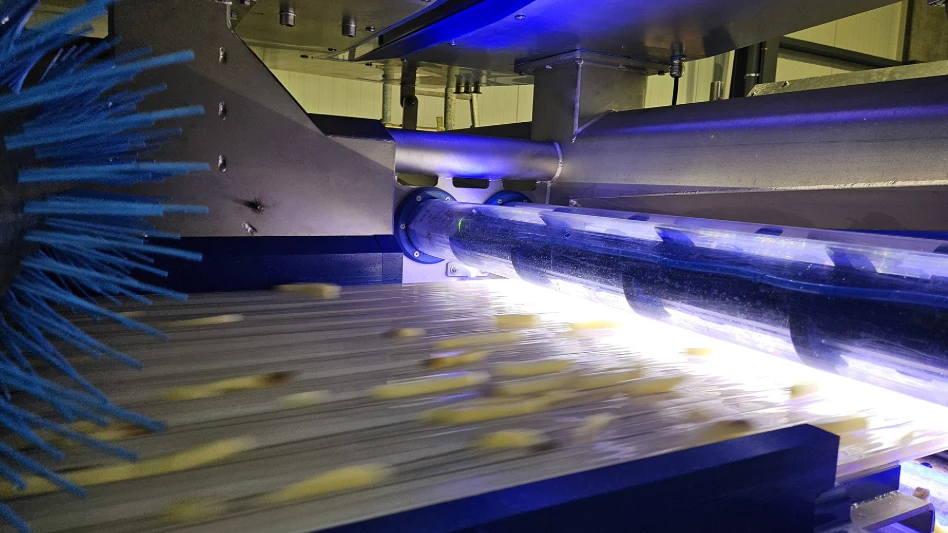
HOW X-RAY WORKS. X-rays are generated by a heated filament creating a stream of electrons and directing them toward an anode, which is embedded in an angled plate. When an electron strikes the anode target, an X-ray beam is emitted and directed down, out of the X-ray tube.
The beam, which is fan-shaped, is directed toward an X-ray detector. This is normally a line of photodiodes positioned under the product conveyor. As the product is transported along the conveyor, it passes through the X-ray fan beam and absorbs some of the X-rays.
As a result, fewer X-rays reach the detector than left the generator, and the detector measures the level of X-rays that pass through the product. Each photodiode (pixel) measurement is converted to a gray level value. The pixels are then combined, line-by-line, into a coherent, formatted image, showing areas of different density, which is analyzed by a built-in purpose-designed computer.
Where products display density or mass variations outside the parameters specified by the user, a reject mechanism removes them automatically from the line. Many X-ray systems can inspect with belt speeds of up to 80 meters per minute in the food industry — and very high inspection rates are possible.
WORKING WITH X-RAY. There is no doubt that X-ray inspection has considerable advantages in many food and beverage processing environments. Easy to install, safe and simple to use, even without previous experience, X-ray offers comprehensive contaminant detection and much more. It quickly and consistently identifies substandard products, reducing product recall, customer returns and complaints, therefore protecting manufacturers’ brands. It helps them demonstrate due diligence and comply with HACCP and other industry standards, retailers’ quality control requirements, and national and international regulation and legislation. The use of X-ray can improve customer confidence, satisfaction and retention and assist in the generation of new business.
The author is Technical Manager, Mettler-Toledo Safeline, Tampa, Fla.
Latest from Quality Assurance & Food Safety
- FDA Releases Produce Regulatory Program Standards
- Invest in People or Risk the System: Darin Detwiler and Catalyst Food Leaders on Building Real Food Safety Culture
- USDA Proposes Increasing Poultry, Pork Line Speeds
- FDA Releases New Traceability Rule Guidance
- TraceGains and iFoodDS Extend Strategic Alliance
- bioMérieux Launches New Platform for Spoiler Risk Management
- SafetyChain Receives SOC 2 Type 2 Certification
- Puratos Acquires Pennsylvania-Based Vör Foods