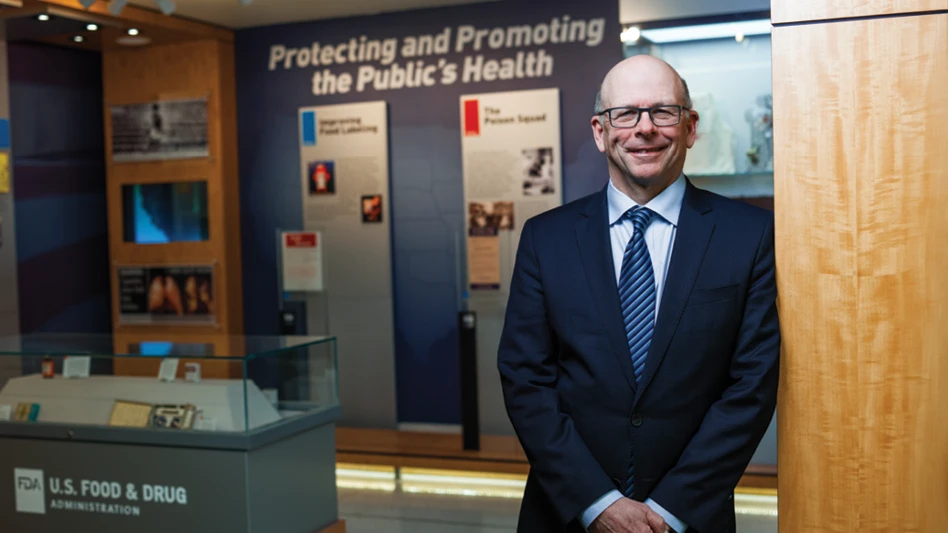
Portraits by Jimell Greene
Jim Jones begins his career at the U.S. Food and Drug Administration (FDA) at a pivotal time for the agency. As he steps into the newly created role of deputy commissioner for human foods, agency-wide reorganization looms on the horizon, and he is tasked with leading the charge in advancing priorities for a proposed unified Human Foods Program and overhauling an organizational system that he calls “fundamentally flawed.”
“Our proposed reorganization is the largest undertaking of its kind in recent history for our agency,” FDA Commissioner Robert M. Califf, M.D., said in August 2023, when Jones’ appointment was announced. “I’m confident that under Jim’s leadership, we will build a stronger organization that will be integrated with other components of the FDA.”
With so much on the table, it’s no surprise that Jones entered his first day on the job on Sept. 24, 2023, with a combination of excitement and anxiety.

“I think that you’re served well by having both,” he said. “These jobs are incredibly exciting, but they’re challenging and they’re daunting. If you’re not feeling some level of anxiety, you’re probably delusional about just how challenging they are. So I felt both excited and anxious, and still do.”
Jones’ 30 years of experience working at the Environmental Protection Agency (EPA), primarily as a pesticide regulator, plus his position on the Reagan Udall Foundation’s Independent Expert Panel for Foods, which submitted a report on the operational evaluation of the FDA’s Human Foods Program to the agency in December 2022, have prepared him for the challenge.
“I’ve been pleasantly surprised at just how transferable the fundamental executive functioning is from my previous job to here,” he said. “These are both basically public health agencies. They’re looking at different aspects of public health, but it involves incredibly complex disciplines across multiple scientific disciplines, law, policy and economics, and integrating all of these disciplines to make decisions that are involved in protecting public health. And you never have perfect information. That’s basically what I had to do in my previous executive jobs at EPA, and that’s what I’m being asked to do here, and that is very transferable.”
QA caught up with Jones in February at the FDA’s Silver Spring, Md., campus to learn about what he’s been up to in his first several months on the job and what his hopes are for the future of the agency.

Quality Assurance & Food Safety Magazine: What originally drew you to the field of food safety, and what attracted you to the role of deputy commissioner for human foods?
Jim Jones: I was a pesticide regulator [at the U.S. EPA], which is fundamentally a food safety-related job. It’s a different aspect of food safety. It’s more akin to the chemical safety work that we do here at FDA. So I have a long history of working on food safety-related issues, just from a different perspective.
I had been out of government for about six years when a number of individuals encouraged me to apply for this job. And at first, I was like, “Well, I’m not sure I’m ready to get back into the fray.” But the more I thought about it, the more I realized just how much I missed being involved in something as meaningful as protecting public health. And the more I thought about it, the more excited I got about it. So I threw my hat in the ring, and I’m very excited that I did.

QA: You said you got out of government for a while. What were you doing during that time?
JJ: I worked for a trade association for about three years, and then I started a consulting firm, and I was doing consulting.

QA: What did you learn during your time as a member of the Reagan Udall Foundation’s Independent Expert Panel for Foods?
JJ: A couple things. The first one — and I’m now experiencing the efforts to correct this one, as it was one of the principal recommendations of the Reagan Udall Foundation report — was that the organizational structure was just fundamentally flawed, and it was creating a lot of difficulties within the organization, in particular around clarity of who has decision rights. That may sound like a relatively simple issue, but it actually has repercussions that play throughout the organization when it’s not obvious to anybody in the organization, actually, who’s going to be able to make this decision. So that’s already been addressed with the creation of the Deputy Commissioner for Human Foods and my appointment into that role.
In the panel, as we talked to stakeholders, it was remarkable, whether they were in academia, the public interest community or industry, just how uniformly stakeholders were impressed with the staff who works here, which reinforces the idea fundamentally of a structure problem. There was consensus that the agency is not resourced well enough, which I can assure you is true. But everybody had nothing but the highest praise for the employees who work here, which was my experience when I was at EPA, and it has been absolutely my experience since I’ve been here at FDA.

QA: What have you been working on since you started?
JJ: The priorities of the organization are fundamentally how I’m trying to spend my time, and then there’s some process things that I’m weaving into the priorities. And it’s interesting, because you can see the priorities reflected in the reorganization: microbiological safety, chemicals in food safety and nutrition. This reorganization is designed around those things.
I’m trying to bring in, just through some process changes, a greater degree of public participation throughout all of our priorities, as well as a greater level of transparency. I’ve spent a lot of time with the stakeholder community, making sure I understand what matters to them, what doesn’t matter to them, cultivating a couple of coalitions that have come together that are very broad in their representation, which I think is incredibly helpful if you’re a government official. And just working on the importance of transparency, that it’s important for us to be very clear about what we’re doing, why we’re doing it and communicate that effectively to the public.
QA: What have you been hearing from stakeholders?
JJ: The stakeholders have been telling me that they like the level of engagement. They like the message of earlier engagement on issues before we get too far down the road. I say both internally and externally that the most important time to engage stakeholders is really before you’ve decided what path you’re going to take, because that’s when you’re open to the most and different ideas. Hearing from stakeholders before we charted our course is the most important time to do that. And stakeholders want that opportunity. They want to get in before we really decide what we’re going to do and where they’re in a position of trying to talk us into something or talk us out of something, as opposed to when we’re coming to them, like, “Here’s the problem. We are open to hearing your suggestions. What do you think?” That’s true for the industry and for the public interest community.
QA: What are some of your goals as you enter this new role?
JJ: They line up with the priorities. I want us to make progress on nutrition, which in this country is creating significant health problems for us. We are seeing for the first time in decades a decline in the average lifespan. Part of that is related to diet-related chronic diseases. I want to see us actually make some progress in that space.
We’ve got to get more actively involved in evaluating existing chemicals — chemicals that have been approved 50, 40, 30, 20 years ago. We’ve learned a ton since some of these chemicals were first allowed on the market. We need to get in there and start assessing them. And so ultimately, I want to see that we are improving chemical safety.
And I would very much like us to get ahead of some of the microbiological issues that we struggle with as a country. And frankly, everyone around the world does. Traditional food safety, reducing the incidence of foodborne illness.

“I’m very excited about getting the new organization into place. I think that our ability to be effective is going to be significantly increased in the new organization versus the existing one.” — Jim Jones
QA: What are the greatest challenges you anticipate facing?
JJ: I think I already have seen it. The scope of the responsibilities is incredibly broad. Things are coming at you in a pretty rapid-fire way pretty much all the time. And so not losing focus on these three areas where I would like to see significant holistic progress because you’re so focused on all of the fire drills that are constantly working throughout the system. Keeping some focus on what we need to do to make meaningful progress across these three priority areas and not letting the day-to-day be a distraction.
QA: That sounds really challenging. How do you manage that?
JJ: You’ve got to carve out time. And actually, one of the ways that I do that, other than get up early and stay up late, is traveling. I mean, everybody’s different, but getting on the road actually helps me to get a little bit of space from the fire drills. Also, in the actual act of traveling, my mind gets a little more freed up to think more about these longer-term priorities, and hearing what people outside of the Beltway think about what we’re trying to do is also helpful. But then also you’ve got to schedule some time in your day that is not about the crisis. It’s about the longer term.
QA: You’re doing an On the Road with Jim Jones video series as you travel around the country talking to stakeholders. What have you learned so far from it?
JJ: When you have an organization of this size, you’ve got about 1,000 people who are based in the DMV [D.C., Maryland and Virginia] and another 1,000 people in field programs, whether they’re in laboratories or they’re inspectors and investigators spread throughout the country. It’s tricky to communicate effectively with everyone all the time. One way to do it is by recording what you’re doing.
In many ways, my audience are the people who work here at FDA. And by that, I mean whether you’re in the office in Alameda [Calif.], or you’re an employee in College Park [Md.]. So going out and actually experiencing some part of the reality, whether it’s with a group of stakeholders, farmers in Salinas, Calif., or our colleagues in the state ag departments who enforce the Produce Safety Rule, or going into one of our laboratories and talking about what you’re experiencing, is a way to communicate internally as well — if you’ve recorded it. Otherwise, the only people who see you are the people who are literally in the room with you. I’m sure people value getting an email from me with an update, but I think it’s more impactful to actually communicate to a large number of people through talking about what you’re doing.

QA: What are your hopes for the future of FDA and the proposed Unified Human Foods Program as the reorganization takes place?
JJ: I’m very excited about getting the new organization into place. I think that our ability to be effective is going to be significantly increased in the new organization versus the existing one. It’s a critical first step. As an economist would say, it is necessary but not sufficient. But if something is necessary, it means you have to do it. And so if we’re really going to get to where we ultimately want to be around these priorities I’ve discussed, we’ve got to get this reorganization behind us, and then we can move on to some of the other basic job execution activities that the new organization will allow us to be better at.
QA: When can we anticipate that the reorganization will be implemented?
JJ: The steps that we’re going through right now are pretty much out of FDA’s control. There are multiple steps that are required for reorganization. There are other entities in the government, executive branch and legislative, who play a role, and they don’t work for us, so it’s hard to predict.

“I’m trying to bring in a greater degree of public participation.” — Jim Jones
QA: What new technology or innovations get you excited about food safety?
JJ: We have a rule in place that requires those along the supply chain of the production of food to have traceability. The technology that they are ultimately going to deploy is, I think, going to be one of the big breakthroughs that will allow us to have earlier interventions in outbreaks, get to the actual source of the outbreak more quickly and limit what I refer to as collateral damage, where we can be so specific about what needs to be recalled that only those who are involved in the contamination issue that you’re worried about are affected. I think that the use of artificial intelligence will help us become faster and better at predicting where problems may be. We can’t sample everything, nor would you want us to. There would be nothing to eat if we sampled everything. It’s just not possible. So being smart about what we sample. Where is something more likely to be a problem than not? Using artificial intelligence and machine learning to get us smarter at that I think is also really exciting.
Also, how we can use information to better do our jobs? I think in the nutrition space, there’s some really interesting work that we’ve done that took a really long time, but having done it, subsequent times are going to be more efficient. There’s a tremendous amount of information on food labels. So, extracting that information to be able to speak to how much sodium is in the diet of Americans — how can you change that level? It requires you to know what’s actually in products, and we can do that now. Same thing with added sugars and saturated fat. There’s an incredible wealth of information that exists, and how we can tap into that to help us do our jobs is also incredibly exciting.
The same is true in the microbiological space, where we know that the private sector holds a ton of information, and working with them in a way that they’re comfortable with us using it so that we can get smarter about how we manage microbiological risks in the future is also a really exciting area.
QA: How do you make companies feel comfortable enough to share that data?
JJ: It’s a trust issue, and we’re going to need to demonstrate that we can be trusted with it. What I hear from companies is that their anxiety is that they don’t want it to be used for enforcement-related purposes. We are saying we only want to use this for purposes of being better in the future, not looking backwards. Looking backwards would be an enforcement case. In the future it would be what is this data telling us, and how can we use it in a way that we’re better, smarter, more effective in how we write a guidance or a regulation or where we focus our energies? It’s a little bit of a chicken and egg thing, but at some point, I think someone’s going to say, “You know what? I think we can trust them.” And then we’re going to have to behave in the way that we said we would. That’s how you build trust.
QA: What gives you hope that food can become even safer?
JJ: A combination of the incredibly dedicated, talented people who work at the Food and Drug Administration, this reorganization that we’re going through and the advances in technology that are going to allow us to more quickly and effectively make the appropriate interventions. All of those things make me confident that we’re going to see a safer food supply in this country.
Explore the March/April 2024 Issue
Check out more from this issue and find your next story to read.
Latest from Quality Assurance & Food Safety
- Chef Robotics Introduces Pat-Down Capability for Meal Presentation and Sealing
- USDA Launches Regenerative Pilot Program
- Indoor Ag-Con Adds Food Safety Track to Conference Lineup
- IDFA Recognizes Federal Officials for Support of U.S. Dairy Industry
- Tetra Pak Acquires Bioreactors.net
- Fresh Del Monte Receives Rabobank Leadership Award
- São Paulo Earns Guinness World Record for Largest Municipal Food Security Program
- KPM Analytics Releases Ready-to-Use NIR Calibration Packages