
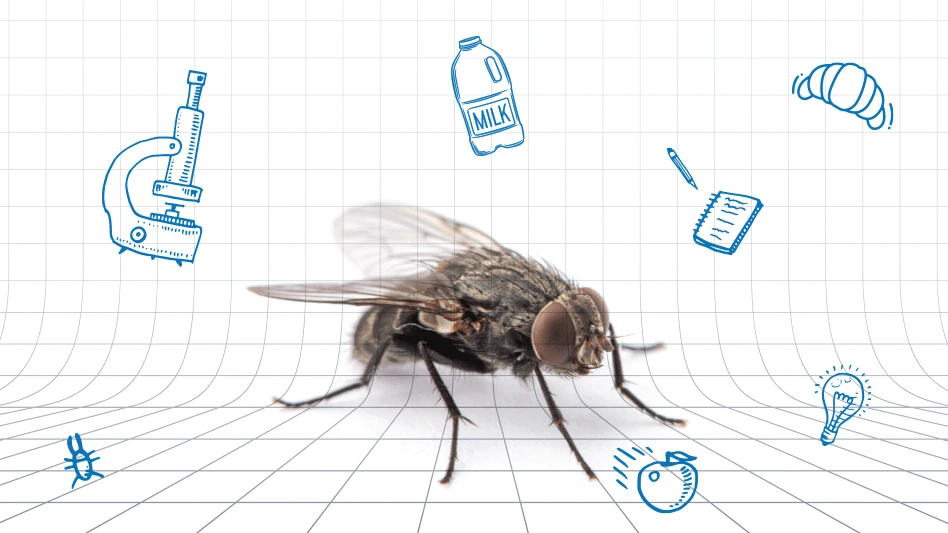
Researchers are always looking for new ways to prevent and control pests found in food processing and storage facilities. The more we know about their behavior, food preferences, and how their biology works, the better we can manage these pests and keep them out of the food supply. Let’s look at some of the projects published from January 2024 to April 2025.

HOUSE FLIES.
It’s well known that house flies (and other flies) are capable of mechanically transmitting many foodborne pathogens. They are a threat to human health as well as contaminating food and food contact surfaces.
In one study, tests were done with four different insecticide baits labeled for house fly control. Since we can’t always get to the adult flies, the testing was done on larvae. Mortality ranged from about 65-82%, which isn’t bad when you consider these products are geared to adults. Getting these products close to larval habitats can increase mortality rates.
It’s also important to find that favorite food source, especially if there are multiple ingredients being used and end products produced. In the study, adult house flies were more attracted to food sources with higher protein. Surprisingly, skim milk powder attracted them more than sucrose.
The same study looked at insect growth regulators (IGRs) and fly larvae. It’s been shown that IGRs are effective on many pests, but this study delved a little further. The researchers found that IGRs decrease larvae’s digestive enzymes and destroy cells in the mid-gut. This is great, because aside from not letting the larvae complete development to the adult stage, IGRs are likely reducing the damage they cause as larvae.
Insect light traps (ILTs) are found throughout food processing and storage facilities. They are intended to intercept incoming flying insects and serve as monitoring devices. However, there isn’t too much data to support their efficacy.
In this study, scientists found that house fly peak activity was from mid-morning to afternoon. Older flies, males and starved flies were more attracted to ILTs. Sanitation is important to limit their food source and get them flying towards the light.
Fun Fact: House flies are attracted to the color blue. Not a dark blue, like navy, and not a light blue, like sky blue, but a medium blue color.

DERMESTID BEETLES.
Worldwide, there are over 2,000 species of dermestids, with around 124 species in North America. Though they are all similar in their preference for high-protein foods, each is still a bit different. One study looked at numerous pest species commonly found indoors in and around foods. It found a wide difference in mortality with different insecticides. If these beetles are a continued problem in a facility, it’s worth switching insecticides for better control.
Researchers looked at the development of the hide beetle (D. maculatus) specifically. As with all insects, there is an upper and lower temperature limit for their survival. These beetles couldn’t develop below 10oC (50oF) or above 40oC (104oF). Their fastest development was around 35oC (95oF), and it took them just 36 days to go from the egg stage to the adult stage. Interestingly, as their populations increased, their development time decreased. Letting these go unchecked can really compound the problem.
If you are using pheromone monitors — and you should be using pheromone monitors — their range isn’t far. Scientists showed that for Trogoderma species, it is about 6 centimeters (2.4 inches). This is important, because pheromone monitors will not capture everything. If they are in the wrong locations, they may not be attracting the beetles, thereby giving a false sense of security. While these should not be placed directly next to a door, they will not draw beetles in from the outdoors.
Fun Fact: A genus of dermestids (Apsectus) feeds on spider webbing and dried spider eggs.

GERMAN COCKROACH.
Cockroaches have been pestering people for approximately 2,100 years, according to studies. That’s given them plenty of time to adapt to the conditions people provide for them. We keep fighting back. Insecticides are readily available to the public, so scientists looked at those consumer liquid products.
When there was direct exposure, meaning the product directly contacted the cockroach, there was anywhere between 100% to just 4% mortality. That decreased significantly when it was indirect contact. Even when cockroaches were forced to stay on a treated surface, it took them between 24-120 hours for full mortality. It’s a great reminder why professional products are best for pest control.
There are baits for cockroaches, too — so how did the consumer products do against professional products? In the lab with controlled environments, they caused about the same mortality. That changed when they did field trials. Professional products applied by professionals were more effective and faster than consumer baits. Researchers also looked at cost, and while consumer products were cheaper, it’s not a good idea to have a slower acting treatment, especially in food facilities.
Cockroaches are a contamination hazard. They are also carriers of many foodborne pathogens. A study looked at their ability to carry Salmonella Typhimurium, the major causative agent of foodborne illness. When cockroaches were fed with contaminated food, not only did researchers find pathogens carried on the outside of their body, but they also spread through their digestive tract, and their feces were contaminated.
Sanitation reduces food sources for cockroaches, but it can also eliminate pathogens so there are less for them to spread around. Another study showed cockroaches could carry antibiotic-resistant strains of bacteria.
Fun Fact: One study of pesticide-resistant German cockroaches found that they required eight times the label rate of two different insecticides to accomplish 100% mortality.

FRUIT FLIES.
Fruit flies seem as if they magically appear out of nowhere. That’s because they communicate with each other.
In a broad research review, study authors found that the pheromones fruit flies produce are highly attractive. Fruit fly pheromones attracted other fruit flies to a food source. Larvae will cooperate to dig tunnels in the food for protection. Males produced more pheromones in larger groups and were more successful in mating. There was even a pheromone coating on the eggs that deterred larvae from cannibalizing the eggs. The authors hypothesized that the pheromones were more attractive than the food smells.
These small flies were more successful when they were in larger groups. Females produced more eggs, and their egg laying was grouped together on the food source. When they were isolated, they exhibited less sleep, overeating, reduced lifespans and higher aggression. They were also more prone to freeze when predators were near, while the grouped flies would fly away.
Fun Fact: Former opponents fight differently with each other than with unfamiliar ones. This suggests flies can remember the outcome of past social encounters and recognize each other.The more flies there are, the better they do. Since they can develop in only a few days, sanitation becomes essential to keep their numbers down and the population stressed out.

INDIAN MEAL MOTHS.
These little moths are found all over the world, infesting many different foods in many different locations, from food processing facilities to grocery stores to home kitchens. One of the biggest problems is that the larvae are in the food source doing the damage while the adults are flying around.
A recent study on mating disruption showed excellent results in pet food stores. There was a 34-95% reduction of moths over 12 months with three applications of mating disruption. The adult moths are short-lived, and if they can be prevented from mating for just a few days, they can’t lay any eggs. No eggs means stopping their population — and the infestation. That doesn’t prevent introductions of new moths on incoming products or from the outdoors. Inspections and exclusion are still necessary, but the mating disruption will affect the adults as soon as they emerge.
Some stored product pests can chew through packaging to get to the foods inside. Indian meal moths can’t chew packaging. What they can do is find the tiniest of holes in packages, and they will lay their eggs right next to them. Scientists measured the eggs and found they were 0.3-0.5 millimeters. Once the larvae hatched, it was able to squeeze through a hole just under 1 millimeter. For reference, that’s the size of a sewing needle or a grain of salt. What was more impressive is that research showed the female would seek out these small openings and specifically lay eggs very close to those holes.
Fun Fact: Scientists reported the first record of the Indian meal moth beyond the South Shetland Islands at the Chilean Yelcho scientific station on Doumer Island, close to the west coast of the Antarctic Peninsula. Yep, they found Indian meal moths in Antarctica!

RED FLOUR BEETLES.
These beetles are notorious for getting into grain-based foods. They are often inside pieces of equipment and other hard-to-reach areas. Getting insecticides to where they are hiding is tough.
Researchers wanted to see what happened when they were exposed to an insecticide, but not enough for mortality to occur. The beetles’ recoveries were faster when there were higher temperatures and humidity and when food was present. What was unexpected was that “any amount of flour, even a dusting, allowed for 90% recovery,” according to the study. If there was no food, there was no recovery.
That’s a great reminder of how important sanitation is. However, it’s impossible to clean up every last granule of flour in an entire structure. Every bit does count, though.
Another study looked at two populations of flour beetles: one prone to dispersal, and one with low dispersal rates. Turns out, they prefer to be together. Flour beetles with low dispersal rates had slightly higher reproduction and female lifespan. Since these pests can live up to a year in the adult stage, each extra day they survive, they lay more eggs.
Fumigations are sometimes necessary when pest problems are widespread. Unfortunately, we only have two fumigants available, and one is only for grain storage. There have been a few projects now on ethyl formate. For flour beetles, it was effective, and there was no cross-resistance with phosphine. A separate research review found it effective on merchant grain beetles, rusty grain beetles, lesser grain borer, cigarette beetles and cowpea weevils. While tests are ongoing, the ability to rotate active ingredients when fumigating is beneficial.
Fun Fact: In a laboratory test with wheat, rice, corn, cowpea, sorghum and barley flour, flour beetles developed the fastest on wheat flour (42 days) and slowest on cowpea flour (65 days).

HOUSE MICE.
Mice want to go to areas that are protected. When they get evicted from their current spot, they travel elsewhere.
Researchers looked at construction sites and buildings nearby. It makes sense that they found the closer a building was to a construction site, the more rodents were found. If construction or other disturbances are planned, it will help to put extra bait stations and traps out.
Other things stress mice out, like the quality of their food. The less food they have, the less they mate and the quicker they perish. When their quality of food went down, researchers found similar effects. Their reproductive rate was significantly reduced, and their growth rate decreased.
Another study showed that when they were stressed, mice had more avoidance behavior, reduced foraging activity and more freezing than fight-or-flight behavior. The more mice can be forced out of their habitat, starved and stressed, the more they will go to food baits and traps in dark boxes.
Speaking of baits, numerous studies showed rodenticide resistance in many different countries. Make sure the pest control team is rotating baits regularly. The active ingredient of the rodenticide needs to be changed to prevent more resistance.
Fun Fact: An early representation of the mouse can be seen in ancient Egypt from 2,500 BC. The pest was depicted breeding and confronting a cat in the tomb of Baqet III.
MORE RESEARCH, FEWER PROBLEMS.
Research gives us valuable information to deal with pest problems. Some behavior data could point us to the most likely spots for a pest to be in, saving time in inspections. Other facts on food preferences can also do that. Knowing how pests grow allows for better timing in sanitation schedules and pesticide applications. Science allows us to be better at our jobs, protect the food supply and keep customers happy. Let’s see what they come up with next year!
Explore the May/June 2025 Issue
Check out more from this issue and find your next story to read.
Latest from Quality Assurance & Food Safety
- Chef Robotics Introduces Pat-Down Capability for Meal Presentation and Sealing
- USDA Launches Regenerative Pilot Program
- Indoor Ag-Con Adds Food Safety Track to Conference Lineup
- IDFA Recognizes Federal Officials for Support of U.S. Dairy Industry
- Tetra Pak Acquires Bioreactors.net
- Fresh Del Monte Receives Rabobank Leadership Award
- São Paulo Earns Guinness World Record for Largest Municipal Food Security Program
- KPM Analytics Releases Ready-to-Use NIR Calibration Packages