
With the advent of a globalized supply chain, food safety risks are becoming all the more prevalent in this day and age. Everything from fresh produce to food contact surfaces suffer from microbial contamination risks that can lead to problems like foodborne illness — which, according to the World Health Organization, almost 600 million people fall ill from, and is fatal for over 420,000 individuals.
Tried and tested methods to combat microbial contamination such as conventional thermal processing techniques have been in use for decades; processes such as pasteurization and canning are in widespread use but are known to cause permanent changes to sensory and nutritional properties.
An obvious answer to these woes might be non-thermal processing techniques, and these methods have been researched for centuries. As far back as 1899, scientists like B.H. Hite studied the use of pressure to inactivate microorganisms, and in the 1960s, Heinz Doevenspeck studied how pulsed electric fields inactivate microbes. Although there are a number of novel non-thermal processing technologies that could potentially achieve pasteurization standards, one of the most promising of these could be cold plasma technology (CPT).
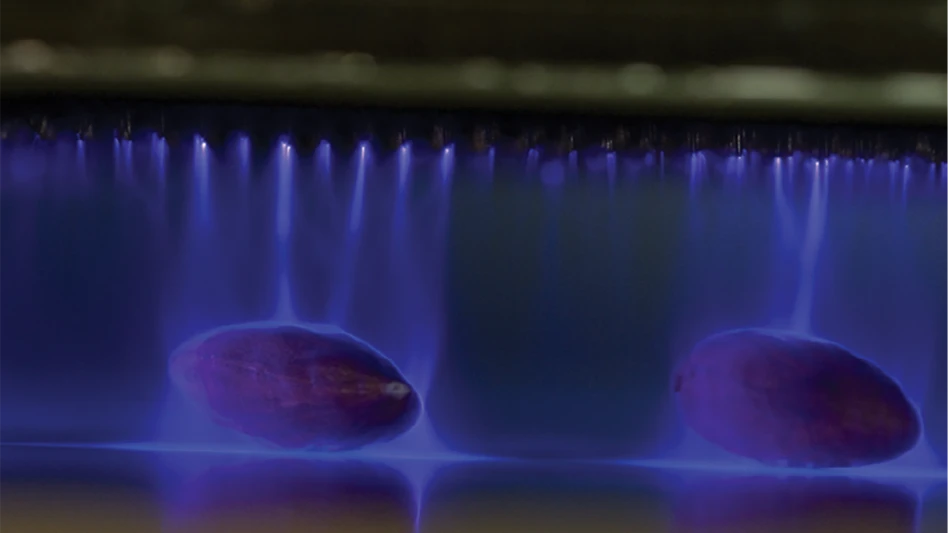
HOW IT WORKS. The basic mechanism of CPT involves atmospheric air (or argon/nitrogen) being subjected to high amounts of voltage, preferably through a dielectric barrier, which generates a cocktail of free radicals such as reactive oxygen and nitrogen species — this includes excited nitrogen, atomic nitrogen and nitric dioxide. These together act to disrupt the cell membranes and/or cell walls of microorganisms, effectively inactivating them or making them extremely susceptible to inactivation. This substance, scientifically termed as plasma, can be applied to food products and food contact surfaces alike.
Dr. Brendan Niemira, a research microbiologist with the USDA’s Agricultural Research Service in Wyndmoor, Pa., and a pioneer in the field of CPT for over 25 years, recalled working on the subject in his early days of research.
“[There’s] this complex mixture of reactive chemical species coming in that are part of the plasma chemistry that would perform the same antimicrobial functions as chlorine and quaternary ammonias and other such things that we’re currently using in the sanitation process,” he said. “And I saw a lot of great potential here, a lot of upsides.”
HOW CAN IT BENEFIT THE FOOD INDUSTRY? Cold plasma is a versatile piece of non-thermal processing technology. There have been studies conducted on its applications in various sectors of the food industry, including nutrient retention, protein modification and starch modification. One of the many capabilities of CPT is to facilitate sensory property retention of food products, making it an excellent alternative to conventional methods of chemical sanitization and ideal for thermolabile products.
Arguably the most crucial subject of study of cold plasma is the antimicrobial effect it has on a broad range of microorganisms, including viruses, mycotoxins and bacteria. A demonstration of the aggressiveness of the antimicrobial effect of CPT is the effect it has on the degradation of biofilms, which are notoriously hard to eliminate. Specifically, cold plasma has been noted to degrade the polysaccharides that are commonly present in biofilms, which has been demonstrated by Niemira and his colleagues.
“I have shown this in my research with E. coli and Salmonella, and other people have shown it with other kinds of biofilms; the [cold] plasma actually will go in and it will degrade the mechanical structure of the biofilms, and it will either injure or kill organisms inside the biofilms,” he said. “Sometimes those membranes are torn apart and the bacteria will die. Sometimes you get membrane perforation and then they’re susceptible to osmotic potential, so you get sublethal injury.”
In the context of antimicrobial activity, CPT can also play a role in sanitization and cleaning procedures. Traditional sanitization techniques, while effective, have the disadvantage of needing long contact times, and when conducted by manual labor, run the risk of ineffective sanitization. CPT, however, needs only miniscule contact times, as explained by Niemira.
“We applied [cold plasma] and we were able to get two- and three-log reductions of adherent biofilms on these surfaces within just 15 seconds,” he said. “Really, really quick treatment, and that’s without any mechanical scrubbing, and that’s completely waterless.”
This technology can also be used in collaboration with existing sanitization standard operating procedures (SSOPs), thereby diversifying cleaning schedules and increasing the likelihood of pathogen elimination.
“So, you can reduce your chemical usage and you can maybe shift from one type of chemical sanitizer regime to a different one that might be more sustainable, might be less environmentally problematic and still get the food safety metrics that you’re looking for,” said Niemira. “Plasma is a great technology, not just as a standalone process, but also in synergistic combination with other food processing technologies.”
SUSTAINABILITY CONSIDERATIONS. With sustainability goals and practices being adopted by companies worldwide, it’s imperative to use technology that can help facilitate it. Widely used chemicals in the food industry such as chlorine and fungicides have been known to be environmentally detrimental. This is where CPT comes into the picture: CPT is generated from common gases such as air, argon and nitrogen, and the reactive species, after interaction with biological surfaces, revert to their original states once the source of electricity is removed, effectively dissipating the plasma. Usage of CPT does not leave any biological or chemical residues behind.
This lack of residue and relative simplicity of machinery and source material also means that CPT is a technology that can be used in various locations and operations, such as catering.
“You just need to have a machine for the source of electricity. And with that, you just pull some air, filter it, combine it with the electricity,” said Niemira. “And now you’ve got a sanitizing process that you can apply to your food prep areas, you can apply it to your packages, you can apply it to your overpacks that go onto the trays that go onto the truck.”
According to Niemira, the absence of residue also makes CPT a great candidate for onsite operation sanitization.

“Even if you are going to one of the aqueous forms of plasma, like plasma-activated water or plasma-activated mist, you’re generating sanitizer on site as you need it,” said Niemira. “If you’re done with your process or if the production line is shifting to something else for a day, and you don’t need that anymore, you just turn the machine off, and then you don’t have bottles of sanitizer that might be appropriate for only one line.”
The absence of chemicals and residues in CPT also has unexpected advantages that extend to sectors of the food industry where traditional sanitizing techniques cannot be used, such as organic foods.
“Because of the constraints of organic production, the sanitizers you might otherwise rely on are not available to you,” said Niemira. “So, you have to rely on other kinds of technologies. That’s where innovative and alternative processes like cold plasma might have a role.”
POTENTIAL BARRIERS. Although in the long run cost and accessibility of the technology may not be barriers due to simplicity of source material, it is important to note that CPT right now is only capable of eliminating surface contaminants in a product.
“So, if you’ve got a chicken breast, and if you apply plasma, it’ll treat what’s on the top of the skin. But if you’ve got contamination through the skin, it’s not going to go through that,” said Niemira. “It’s like any other process. There are some things that [cold plasma] is going to be really great for, and there are some areas where you know it’s not going to be the best choice.”
Other disadvantages to the general acceptance of CPT could include potential barriers to regulatory approvals in countries like the United States due to the fact that the exact mechanism of microbial inactivation is still not completely understood.

“There’s a lot of people that are working on it and a lot of very promising data right now,” said Niemira. “To my knowledge, it still has not passed regulatory approval in the United States for use, and neither in Europe.”
WHAT DOES THE FUTURE ENTAIL? The nascent nature of CPT puts it in a unique position where researchers have the capacity to delve into different kinds of applications that may not be as obvious to the food sector. One development in this regard is valorization of food waste.
“When you have waste streams that are coming out, ordinarily it’s just sort of useless junk, and we’re using plasma chemistry to change what’s in that waste stream to turn it from valueless into value-added product,” said Niemira. “So, you’re recovering valuable stuff from those waste streams.”
The non-food applications of cold plasma technology are also steadily developing.
“There are tons of them,” said Niemira. “Eliminated smokestack wastes and breaking down organic contaminants, stuff that you can’t treat any other way. People are doing that for reification of biofuels and other kinds of applications, relying on plasma chemistry.”
Current research into CPT delves into cold plasma’s inactivation mechanisms and its applications into several non-food and food sectors. Pending regulatory approvals, the economic implications and positive food safety impact of this technology may have potentially widespread ripples throughout the food industry.
Explore the Nov/Dec 2024 Issue
Check out more from this issue and find your next story to read.
Latest from Quality Assurance & Food Safety
- Chef Robotics Introduces Pat-Down Capability for Meal Presentation and Sealing
- USDA Launches Regenerative Pilot Program
- Indoor Ag-Con Adds Food Safety Track to Conference Lineup
- IDFA Recognizes Federal Officials for Support of U.S. Dairy Industry
- Tetra Pak Acquires Bioreactors.net
- Fresh Del Monte Receives Rabobank Leadership Award
- São Paulo Earns Guinness World Record for Largest Municipal Food Security Program
- KPM Analytics Releases Ready-to-Use NIR Calibration Packages