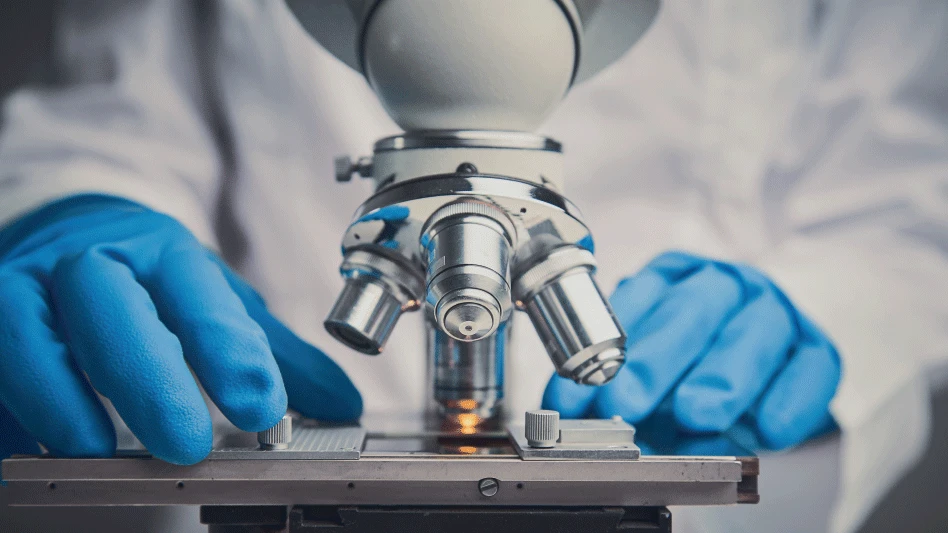
Food Safety Lab Discoveries Advance Pathogen Detection

Research to advance food safety and quality assurance includes recruiting AI as a human eye and infant formula testing that’s as quick as taking a pregnancy test.

© kkolosov | Adobe Stock

© kkolosov | Adobe Stock

Editor's Note: This article originally appeared in the print edition of QA under the headline "Study This: Food Safety Lab Discoveries."

Autonomous vehicles fueled by AI-driven technology also have algorithms that can spot pathogens in samples the human eye can’t see, even under microscope.

A computer-modeled diagnostic kit to test for a deadly pathogen that clings to powdered infant formula before product hits the shelves could save tiny lives in a big way.

These novel approaches and studies are entering the pages of journals and could soon advance best practices in food production and safety. And there’s an ongoing, dire need for new approaches.

Foodborne illness costs the United States more than $17.6 billion each year, according to the U.S. Department of Agriculture. And worldwide, every year the consumption of contaminated foods causes an estimated 600 million illnesses — roughly 1 in 10 people — and 420,000 deaths based on 2022 research by the World Health Organization (WHO).

Here’s a lab bench-side snapshot of lab innovation.

© fotoduets | Adobe Stock

A Prototype to Protect Infant Formula

Vulnerable infants are especially impacted by foodborne illness, with newborn immune systems in early development stages that are not yet prepared to stave off illnesses that might not be fatal to their parents. But they’re life-threatening to brand-new bundles of joy.

Even food designed to nourish newborns can backfire with serious symptoms and health consequences.

Cronobacter sakazakii is an emerging and persistent pathogen detected in some infant powdered formulas and linked to neonatal foodborne outbreaks. Researchers at University of Birmingham in Birmingham, England, U.K., developed the framework for a detection kit to rapidly determine the presence of C. sakazakii — before powdered formula hits the market.

“We need to make diagnostics simple,” said Oladipo Elijah Kolawole, Ph.D., a biomedical scientist at Adeleke University, founder of helix Biogen Institute and honorary associate professor at the Department of Chemical, University of Birmingham.

The goal is to deliver a simple detection kit to use at the production stage that is easy, like testing for pregnancy.

“You want to buy a formula that is safe for your baby,” emphasized Helen Onyeaka, Ph.D., FIFST, FHEA, a food microbiologist at University of Birmingham. “We can prevent the outbreak of severe infection, save lives, reduce medical costs and secure the trust of consumers who use powdered infant formula.”

THE BACKSTORY. Current methods to identify C. sakazakii are polymerase chain reaction (PCR), culture- or biochemical-based and require highly skilled personnel, expensive equipment or long turnaround time. These obstacles make real-time surveillance impossible.

The pathogen itself is a ubiquitous survivor.

C. sakazakii is gram-negative, which means it resists many drugs and antibiotics. It innately passes along “signals” by way of genetic material that cause other bacteria to become drug-resistant, too. Basically, it shields itself and armors other bacteria, a perfect storm for an immune attack.

“It is persistent in dry environments like those found in powdered infant formula, making it a big risk,” Onyeaka said, relating how pathogens possess different “intrinsic factors” that allow them to harbor and manifest in varying food environments.

© Surrender | Adobe Stock

“For example, Salmonella will grow in chocolate because the oil in chocolate protects the pathogen,” she said. “It will not traditionally grow in low-moisture fruit. This bacteria, [C. sakazakii], grows in low-moisture powdered infant formula, where it can survive.”

Another thing about C. sakazakii is how it is “motile,” so it’s quite exploitive. Its cells shift away from unfavorable situations and find new appealing ones. Evicting this bacteria from the body is a significant challenge.

While C. sakazakii prefers dry environments, it’s also a facultative anaerobe, so it can grow with or without O2.

Compounding its reticence as a pathogen are symptoms that easily can be written off as baby stuff. Onyeaka said symptoms of infection include fever, poor appetite, refusal to eat, irritability, crying and lethargy. Soft spots on the top of a baby’s head (where the skull is still forming) called fontanels may present with bulging and are a sign of intercranial pressure and meningitis, which C. sakazakii can cause.

C. sakazakii is also associated with septicemia, an inflammatory response that causes tissue damage and organ failure, and necrotizing enterocolitis (NEC).

Plus, infants can’t talk to you about how they’re feeling, so screening after disease onset usually occurs when it’s too late.

“I’m passionate about creating awareness and to show we need to take this seriously,” said Onyeaka, who specializes in sustainable microbial food security and also serves as deputy director of the Birmingham Institute for Sustainability and Climate Action (BISCA).

Her younger sister recently had a baby and is afraid to give her baby formula, she related. “We need to ensure parents’ trust,” she said.

ENGINEERING A PROTOTYPE. The study published in Food Quality and Safety, a peer-reviewed journal, in January explains the design of a peptide-based kit with a “bioinformatic” technique to rapidly identify C. sakazakii. As Kolawole described, a goal was to make this diagnostic pregnancy-test simple for rapid use during powdered formula production to prevent contaminants from ever reaching the market.

“The traditional methods of detection take time and require sophisticated lab equipment and skilled personnel,” he said.

Testing to develop a kit design required selecting genes associated with the bacteria’s pathology and predicting signal peptides “to target the segment that would trigger an immune response,” Onyeaka explained.

The published paper is titled “Immunoinformatics assisted design of a multi-epitope kit for detecting C. sakazakii in powdered infant formula.” The technique is an advancing bench-to-bedside approach combining immunology, computer science, biochemistry and genomics — data and science — to uncover diagnostic and treatment opportunities.

With this strategy, the team created a computer-modeled detection kit.

WHAT’S NEXT? The diagnostic kit could be a conceptual framework with potential for providing fast, efficient detection. Additional validation through in vitro and in vivo “real life” studies, as Kolawole says, is necessary to validate the research.

This requires industry collaborators, infant advocacy organizations and philanthropic arms that can work together, leverage the University of Birmingham’s expertise and help forward a C. sakazakii food-production test kit to market at a low cost so it’s accessible.

Awareness is of utmost importance.

“This pathogen is quite dangerous, and it goes unnoticed until an outbreak happens,” Onyeaka said. “This pathogen is also not as well-known as Salmonella, E. coli and others, so there is no routine surveillance. It’s very important that we create awareness, and [powdered infant formulas] should be screened because of the consequences that can arise from infestation.”

© Summit Art Creations | Adobe Stock

AI Steers Fast E. Coli Detection

The same deep-learning AI model deployed in self-driving vehicles can also accurately detect microbial bacteria like E. coli in food products.

You Only Look Once (YOLO, version 4) can identify objects at high speeds — other cars, pedestrians, traffic lights, obstacles in the road. The automated data analysis potential of YOLOv4 could significantly fast-forward pathogen identification to three hours versus the potential weeklong wait during gold-standard culture-based methods.

Novel research out of University of California Davis uncovered a technique combining optical imaging and the YOLOv4 algorithm to identify E. coli on samples with 94% accuracy. The study, published in the journal Applied and Environmental Microbiology, presents a promising advance for expediting pathogen detection, elevating food safety and limiting the labor and resource burdens food processors face.

ACCELERATED DETECTION. “The motivation of this project was to accelerate pathogen detection, because culture-based methods can take several days, which is a problem for the food industry, especially considering the shelf life of perishables like produce or meat,” said Luyao Ma., Ph.D., assistant professor at Florida State University, who was a postdoctoral fellow at UC Davis during the project.

The culture-based method of detecting pathogens can require sending samples to a lab. Then there’s “grow time” while bacteria colonize, followed by analysis by a trained technician and delivery of results.

Days pass before action can be taken, which means a potential spread of foodborne illness —including worst-case fatal scenarios — along with potential reputational damage and the expense of recalls.

The dominos continue toppling.

“We’ve been using the culture-based method for a century, and it’s the foundation of modern microbiology, but no one has thought about how to improve this very standard method,” Ma said.

Co-author Jiyoon Yi, Ph.D., is now assistant professor at the Michigan State University (MSU) Department of Biosystems and Agricultural Engineering and was with the UC Davis Department of Biological and Agricultural Engineering during the study.

Yi said, “As an engineer, I’m thinking, how can we replace the need for trained personnel to do the data analysis and make testing faster and more accessible? The motivation was to automate image data analysis to reduce barriers.”

Rather than trained personnel, a deep-learning model, YOLOv4, “reviews” and detects microbe presence. Instead of a multi-day culturing process, optic imaging generates a digital visual for AI analysis.

“This research was the first step to integrate computer vision with pathogen detection in food safety,” Yi said.

Also involved in the interdisciplinary study were UC Davis professors Nitin Nitin, Mason Earles and Nicharee Wisuthiphaet.

UP CLOSE AND AUTOMATED. E. coli was the target bacteria in the study.

Stripping the method down to basics, the study essentially involved two steps: microcolony incubation and optic imaging, followed by real-time bacterial detection using YOLOv4.

Preliminarily, the team performed necessary testing to determine the ideal incubation time, which they learned was three hours — enough time for cell patterns to form that help differentiate bacteria species.

Another precursor involved training the AI model to identify real-world pathogens using biosensing that identifies and produces a “signal” to recognize E. coli activity in a microcolony and then “teach” the model based on collected data.

“Deep learning is a purely data-driven process used with imaging, image data and computer vision,” Yi explained.

The trained AI model can analyze bacterial microcolonies and their “morphology”— with differing characteristics like growth rate, ring count and size that distinguish different bacterial species. Yi compared these formations to fingerprints that the AI algorithm can detect.

Specific identification is central to the study’s success.

Though there are measures to reduce wait time to get results, when growing bacteria for just a few hours, the tiny microcolonies at this stage are virtually undetectable by human eye, even under microscope. This is where AI comes into play as the knowing eye.

“Some bacteria pathogens look so similar we cannot differentiate by our eyes — E. coli and Salmonella look similar,” Yi said. “That is why we use AI to identify bacterial species. We trained the deep-learning model to classify bacteria with high accuracy.”

TIME-SAVING TECHNOLOGY. This breakthrough study proved the success of a three-hour culture, optic imaging of microcolonies and AI-driven analysis discriminating E. coli from seven other common foodborne species with 94% accuracy.

The time-saving technology is a promising step toward improving food safety standards worldwide.

“Once the food is processed [in a facility], it can be tested and, on the same day, you can make sure there’s no pathogens and distribute the product,” Ma said of the “very rapid screening.”

This quick, accurate test could offer food processors on-demand detection without requiring a lab professional on site or risking the time to wait for a standard culture-based analysis. Yi added, “We can still do secondary testing but reduce the amount we need to test by targeting sites that are highly likely to be contaminated.”

WHAT’S NEXT? AI image detection is where the industry is heading. “We are at the first stage,” Yi said.

Ma and Yi said there’s a lot of potential — and a lot more research to be done to improve the practice and apply it to different bacteria and food products. Both are involved in various aspects of applying lessons from this study and building off its results in their current roles at MSU and FSU.

“We are working to improve the accuracy in real-life applications,” said Ma.

For instance, this will include applying the method to detect target bacteria. Ma said, “If we try to detect bacteria from produce, meat and cheese, when we rinse the bacteria from the surface of the food, the samples [we are testing] will not only contain bacteria, but also food debris, so we need to continue teaching the machine.”

An emphasis on avoiding false positives is critical for maintaining consumer confidence in our food processing systems, Ma added. Improved AI model performance is an ongoing project, she said.

“We still need to build out the database, because now we trained eight bacterial species, but there are many more, and we are happy to work with food industries to collect data from real samples,” Ma said. “The more we can train our machine learning, the better it will perform, and everyone will benefit.”

Yi agreed, a wider universe of samples is essential for continued study. “This study was done on liquid food samples from simple to complicated, such as coconut water or spinach-washed water, and we also used irrigation water with unknown microbes,” she explained.

“The study really shows that AI can help implement lab knowledge in real-world settings with a high accuracy level,” Yi said.

The author is a regular contributor to QA.

May/June 2024
Explore the May/June 2024 Issue

Check out more from this issue and find your next story to read.